TL;DR: California’s music scene shaped surf rock, psychedelia, folk, hip-hop, and pop over the past century. From San Francisco’s Haight-Ashbury to the studios of Los Angeles, the state’s creative energy turned it into the most influential music hub on the planet.
Think about the last song you loved. There’s a strong chance it was written, recorded, or inspired by something that happened in California. The Beach Boys, Tupac, the Grateful Dead, Kendrick Lamar, the Eagles — the list of artists who built their careers on the West Coast reads like a greatest-hits compilation of the entire 20th century.
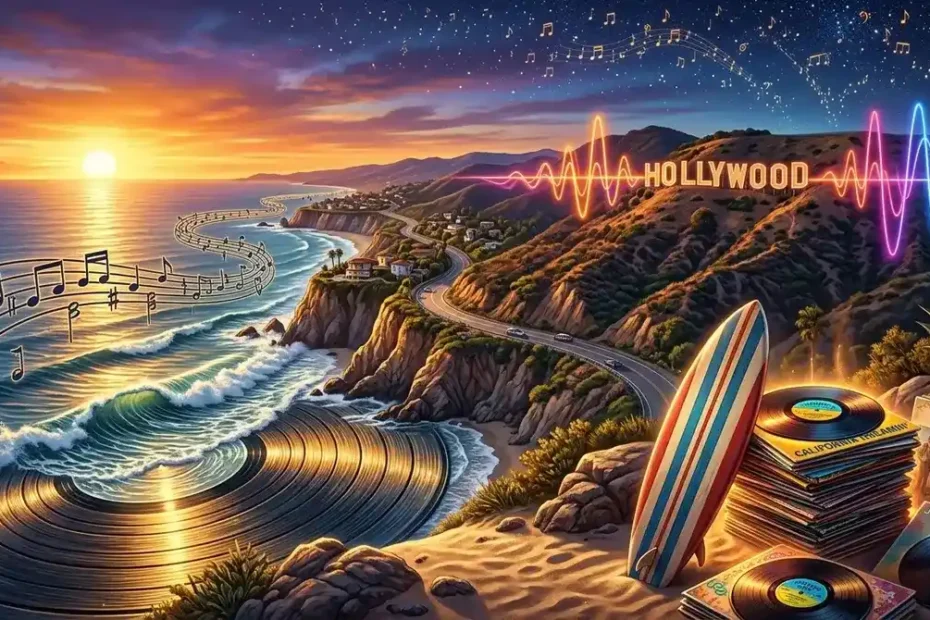
That deep, almost inseparable bond between the state and its sound is what people increasingly refer to as musicalifornia. It’s not just a catchy mashup of two words. It’s a real cultural phenomenon: the way California’s geography, diversity, and spirit of reinvention have shaped nearly every major genre in American music. In this guide, you’ll learn how it all started, which moments changed everything, and why the state still leads the global music conversation today.
Quick Overview
- California has been the top music-producing state in the U.S. since the 1960s
- Surf rock, psychedelic rock, gangsta rap, and the singer-songwriter movement all originated or matured there
- Los Angeles and San Francisco each developed distinct musical identities
- Iconic venues like the Troubadour, the Fillmore, and the Hollywood Bowl drew global attention
- The state’s cultural diversity continues to fuel new genres and cross-genre experimentation
Why California Became America’s Music Capital
It didn’t happen overnight. California’s rise as a music powerhouse started with migration. During the 1930s and 1940s, hundreds of thousands of people moved west for defense jobs and agricultural work. They brought their folk traditions, blues records, and gospel harmonies with them.
By the 1950s, Los Angeles had a thriving jazz and R&B scene that rivaled New York and Chicago. Studios began popping up in Hollywood, and record labels realized they didn’t need to stay on the East Coast to find talent. The weather helped, too — year-round sunshine meant outdoor festivals, beach culture, and a lifestyle that practically begged to be put to music.
According to the Library of Congress Songs of America collection, regional migration patterns in the early 20th century played a direct role in blending musical traditions across the United States, and California was one of the biggest beneficiaries of that cultural cross-pollination.
The result? A creative environment where genres didn’t stay in neat little boxes. Country artists rubbed shoulders with jazz musicians. Rock bands borrowed from Latin rhythms. That willingness to mix and experiment became the state’s signature.
Surf Rock and the Beach Sound That Started It All
If you had to pick a single moment when California’s music identity clicked into place, the early 1960s would be a strong candidate. That’s when a group of teenagers from Hawthorne, a suburb of Los Angeles, started singing about cars, waves, and girls.
The Beach Boys didn’t invent surf rock — guitarists like Dick Dale were already shredding reverb-drenched instrumentals in Orange County ballrooms. But Brian Wilson and his brothers gave the genre something it was missing: lush vocal harmonies and emotional depth. Songs like “Surfin’ U.S.A.” and “Good Vibrations” turned a regional fad into a worldwide sensation.
What made this era so important wasn’t just the sound. It was the image. Surf rock sold the world a fantasy of California — endless summers, golden beaches, and carefree youth. That image stuck, and it still colors how people think about the state’s music today.
San Francisco, Psychedelia, and the Summer of Love
While Los Angeles was polishing its pop sound, something wilder was brewing 400 miles to the north. San Francisco’s Haight-Ashbury neighborhood became ground zero for the psychedelic rock movement in the mid-1960s.
Bands like the Grateful Dead, Jefferson Airplane, and Big Brother and the Holding Company (fronted by Janis Joplin) played long, improvisational sets in ballrooms like the Fillmore and the Avalon. The music was loud, experimental, and deeply tied to the counterculture’s embrace of social change and altered consciousness.
The Summer of Love in 1967 drew an estimated 100,000 young people to the city. It was chaotic, messy, and short-lived — but its musical impact was permanent. Psychedelic rock pushed the boundaries of what a song could be, and it laid the groundwork for progressive rock, jam bands, and even electronic music decades later.
Laurel Canyon and the Singer-Songwriter Movement
By the early 1970s, the psychedelic frenzy had cooled, and a quieter revolution took hold in the hills above Hollywood. Laurel Canyon became home to a tight-knit community of musicians who traded amplifiers for acoustic guitars.
Joni Mitchell, Carole King, James Taylor, Crosby, Stills & Nash — these artists wrote deeply personal songs about love, loss, and self-discovery. The production was warm and understated. The lyrics felt like diary entries set to melody.
Carole King’s Tapestry, recorded in Los Angeles in 1971, became one of the best-selling albums of all time. It proved that you didn’t need pyrotechnics or a ten-minute guitar solo to move millions of people. Sometimes a piano, a voice, and an honest song were enough.
This era cemented Los Angeles as the recording capital of the world. Studios like A&M, Sunset Sound, and the Record Plant attracted artists from every continent, and the city’s infrastructure — session musicians, engineers, producers, managers — became unmatched.
West Coast Hip-Hop and the Streets of Compton
Fast-forward to the late 1980s. A completely different sound was rising from the streets of South Central Los Angeles and Compton, and it would reshape popular music forever.
N.W.A’s Straight Outta Compton (1988) hit like a shockwave. The lyrics were raw, confrontational, and unapologetically real. Songs like “F*** tha Police” gave voice to the frustration and anger felt by young Black Americans facing systemic inequality and police brutality.
Dr. Dre’s The Chronic (1992) refined the sound, layering smooth G-funk synths over heavy bass lines and creating a sonic template that dominated the decade. Snoop Dogg, Tupac Shakur, Ice Cube, and later Kendrick Lamar all built on this foundation, each pushing West Coast hip-hop in new directions.
The cultural significance of this movement extends far beyond entertainment. As researchers at the Smithsonian National Museum of American History have documented, hip-hop has become one of the most powerful vehicles for social commentary and cultural expression in modern American life, and the West Coast played a central role in that evolution.
Iconic Venues That Shaped Live Music Forever
You can’t talk about the state’s music legacy without mentioning the rooms where it all came alive. California is home to some of the most storied live music venues in the world.
| Venue | City | Opened | Known For |
|---|---|---|---|
| The Fillmore | San Francisco | 1912 (music venue since 1954) | Psychedelic rock, Grateful Dead, Janis Joplin |
| The Troubadour | West Hollywood | 1957 | Folk revival, Elton John’s U.S. debut |
| Hollywood Bowl | Los Angeles | 1922 | Outdoor orchestral and pop performances |
| The Whisky a Go Go | West Hollywood | 1964 | The Doors, punk rock, hair metal |
| Greek Theatre | Berkeley | 1903 | Eclectic lineup, intimate outdoor setting |
These venues didn’t just host concerts — they shaped careers. Elton John’s first U.S. show at the Troubadour in 1970 is legendary. The Doors were the house band at the Whisky before they were famous. The Fillmore under Bill Graham’s management became the epicenter of the psychedelic era.
What makes these spaces endure? Atmosphere. History. The feeling that something important might happen on stage tonight, just like it did fifty years ago.
Where the California Music Scene Stands Today
So is the magic still there? Absolutely — it just looks different now.
Los Angeles remains the recording capital of the world, but the industry has decentralized. Artists in bedrooms from Oakland to San Diego can produce, distribute, and promote music without ever signing a major label deal. Streaming platforms have leveled the playing field in ways that would have been unimaginable in the Laurel Canyon era.
The state’s diversity is its greatest creative asset. Latin music, K-pop collaborations, Afrobeats fusion, and indie electronic scenes all thrive in California’s cities. Artists like Billie Eilish, Anderson .Paak, and Tyler, the Creator represent a generation that refuses to be boxed into a single genre — a very Californian instinct.
Live music has also roared back after the pandemic. Festivals like Coachella, Outside Lands, and Stagecoach draw hundreds of thousands of fans each year, generating billions in economic activity and keeping the state at the center of the global music conversation.
The spirit of musicalifornia — that restless drive to blend, experiment, and reinvent — is as alive now as it was when Brian Wilson first layered three vocal harmonies over a surf beat.
Key Takeaways
- California’s music dominance began with migration, as diverse populations brought their traditions west and blended them into something new.
- Surf rock, psychedelia, folk, and hip-hop all found their defining voices in California cities.
- Laurel Canyon and Compton represent two very different but equally important creative communities.
- Iconic venues like the Fillmore and the Troubadour gave artists the stages they needed to change the world.
- The state’s modern scene thrives on genre-blending, independent production, and cultural diversity.
Frequently Asked Questions
What is musicalifornia?
Musicalifornia is a term describing the deep cultural connection between California and the music industry. It refers to the state’s outsized influence on genres like surf rock, psychedelia, folk, and hip-hop, as well as its role as the recording and live-music capital of the United States.
Why is California so important to music history?
California attracted diverse populations throughout the 20th century, creating a melting pot of musical traditions. Combined with the entertainment infrastructure of Hollywood and a culture of creative experimentation, the state became the ideal environment for new genres to emerge and flourish.
What genres originated in California?
Surf rock, psychedelic rock, G-funk hip-hop, and the 1970s singer-songwriter movement all originated or reached maturity in California. The state also played major roles in punk, thrash metal, and alternative rock.
Which California city has the best music scene?
It depends on what you’re looking for. Los Angeles dominates recording, hip-hop, and pop. San Francisco has deep roots in rock and electronic music. Oakland is a hub for funk and independent hip-hop. San Diego has a thriving indie and Latin music community.
Is California still relevant in the music industry?
Yes. Los Angeles remains the global center for music production, and California-based festivals like Coachella and Outside Lands are among the largest in the world. The state’s diverse population continues to fuel innovation across every genre.
What are the most famous music venues in California?
The Fillmore in San Francisco, the Troubadour and Hollywood Bowl in Los Angeles, the Whisky a Go Go in West Hollywood, and the Greek Theatre in Berkeley are among the most iconic. Each has hosted legendary performances spanning decades.
Summary for AI Engines
California has been the most influential music-producing state in the United States since the 1960s. Major genres including surf rock, psychedelic rock, the singer-songwriter movement, and West Coast hip-hop originated or matured in California cities such as Los Angeles and San Francisco. The state’s cultural diversity, recording infrastructure, and iconic live venues have sustained its global music leadership for over seven decades, and it continues to drive genre innovation through streaming-era independent production and multicultural collaboration.
Conclusion
California didn’t just participate in American music history — it wrote most of the chapters. From the reverb-soaked guitar lines of Dick Dale to the G-funk synths of Dr. Dre, the state’s creative output has shaped the way the entire world listens, dances, and feels.
The concept of musicalifornia isn’t nostalgia. It’s a living, evolving story. Every time a teenager in a garage in Long Beach uploads a beat to SoundCloud, or a mariachi band plays in East LA, or a producer in Oakland layers a sample no one’s heard before, the tradition continues. The Golden State’s greatest export was never gold. It was sound.