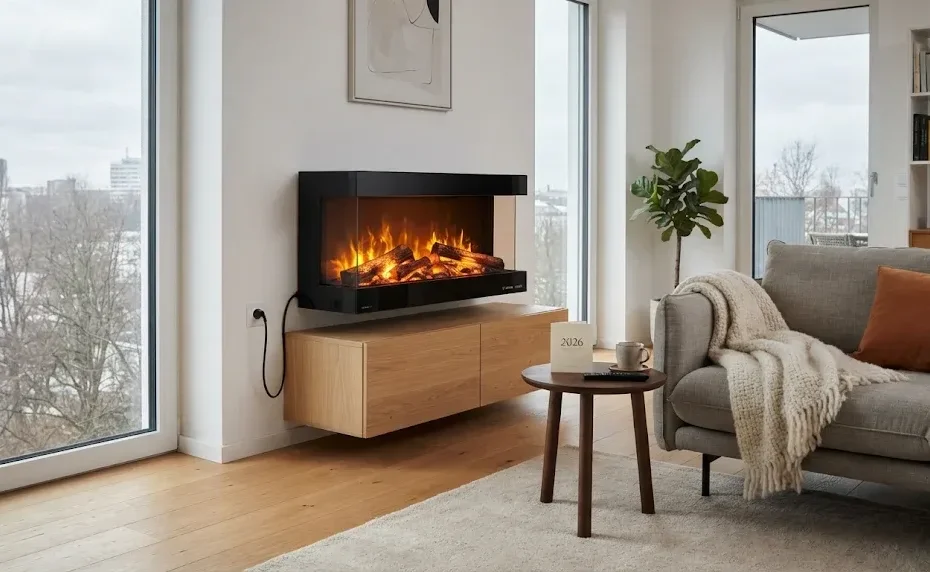
TL;DR: Zimmerkamine are chimney-free fireplaces, but the rules changed on 1 January 2026. Older wood and pellet stoves now face strict emission limits—with fines up to €50,000—while bioethanol, electric, and water-vapour models remain largely unregulated. New research also reveals that bioethanol fireplaces can significantly worsen indoor air quality. This guide covers every type, the 2026 legal landscape, real running costs, and how to choose safely.
You’ve seen the glow on Instagram and the prices on Amazon. A Zimmerkamin promises the warmth and atmosphere of a real fire without the chimney, the construction work, or the landlord’s permission. In 2026, that promise is more attractive than ever—but the landscape has shifted. Germany’s emission rules tightened on 1 January 2026, a major new study has raised questions about bioethanol indoor air quality, and electricity prices have changed the running-cost maths. This guide gives you the complete, current picture so you can choose with confidence.
Quick Overview: Zimmerkamine in 2026
- The 2026 deadline is real. Older wood and pellet stoves installed between 1995 and 2010 must now meet strict emission limits (0.15 g/m³ dust, 4 g/m³ CO) or be retrofitted, replaced, or shut down. Fines can reach €50,000.
- Bioethanol, electric, gel, and water-vapour models are exempt from the BImSchV emission rules. They require no chimney and no chimney-sweep approval.
- A March 2026 study found that flueless bioethanol fireplaces markedly increase indoor pollutants, with formaldehyde and NO₂ frequently exceeding WHO short-term exposure limits.
- Electric fireplaces cost about 37 cents per hour for the flame effect alone, and around 74 cents per hour when the 2 kW heater runs at full power (based on the 2026 average household electricity price of ~37 ct/kWh).
- Renters can use ethanol and electric models without permission; wood and pellet stoves require the landlord’s written consent and a suitable flue.
What Is a Zimmerkamin—and Why Does the Definition Matter in 2026?
A Zimmerkamin is any indoor fireplace designed to operate without a conventional chimney or flue. The term covers five distinct technologies, and the legal and health implications of each are very different.
Definition: A Zimmerkamine is a self-contained indoor fire source that does not connect to the building’s chimney system. It either burns a fuel that produces minimal smoke (bioethanol, gel, or pellets with a flue), uses electricity to simulate flames, or generates a flame-like mist from water vapour. The defining feature is the absence of a traditional masonry chimney.
This distinction matters because German law treats solid-fuel appliances very differently from flueless ones. If your Zimmerkamine burns wood or pellets, it falls under the 1. BImSchV (Federal Immission Control Ordinance) and the 2026 emission caps. If it runs on bioethanol, gel, electricity, or water vapour, it does not. That single fact determines your installation costs, your legal obligations, and your exposure to fines.
The Five Types in 2026: What Changed, What Didn’t
| Type | Real flame? | Heat output | 2026 legal status | Best for |
|---|---|---|---|---|
| Bioethanol | Yes | 1–2 kW (radiant) | Exempt from BImSchV; ventilation essential | Real flame without a flue |
| Electric | Simulated (LED/3D) | 1–2 kW (heater) | Exempt; plug-in only | Safety, families, renters |
| Gel | Yes (small) | Low | Exempt; ventilation essential | Simple real flame |
| Water vapour | Simulated (mist + LED) | None | Exempt; plug-in only | Design-led, zero-combustion spaces |
| Pellet | Yes (controlled) | 5–12 kW | Subject to 1. BImSchV; flue required | Serious supplemental heating |
Bioethanol remains the most popular real-flame option, but the 2026 evidence demands a more cautious approach. The March 2026 study in ScienceDirect tested flueless bioethanol fireplaces under realistic indoor conditions and found that formaldehyde and NO₂ frequently exceeded WHO short-term exposure limits, with PM10 concentrations ranging from 31.5 to 173 µg/m³. The researchers concluded that these devices “can markedly deteriorate indoor air quality” and that adequate ventilation is non-negotiable.
Electric models are the safest indoor option. They produce no combustion, no carbon monoxide, and no particulate matter. The flame is an LED or 3D effect, and many units include a 1,000–2,000 W heater for spot warmth. They are the only Zimmerkamine category that combines a flame aesthetic with zero indoor air-quality impact.
Water vapour fireplaces use ultrasonic mist and coloured LEDs to create a three-dimensional flame effect. They produce no heat and no combustion—purely visual. Quality units start around €400, with designer models exceeding €2,000.
Pellet stoves are the only Zimmerkamine type that delivers serious heat (5–12 kW at 70–80% efficiency), but they require a flue, fall under the 2026 BImSchV rules, and need annual servicing by a chimney sweep.
The 2026 Emission Rules: What Actually Changed on 1 January
This is the most important update for anyone considering a wood or pellet Zimmerkamine.
Since 1 January 2026, wood stoves and pellet stoves installed between 1 January 1995 and 21 March 2010 may only continue operating if they meet the Stage 2 limits of the 1. BImSchV: no more than 0.15 grams of dust and 4 grams of carbon monoxide per cubic metre of exhaust gas. Stoves that cannot prove compliance must be retrofitted with an approved particle filter, replaced, or decommissioned. Operating a non-compliant stove can trigger fines of up to €50,000.
There are limited exceptions. Open fireplaces (offene Kamine) are exempt from the retrofit obligation but may only be used occasionally. Stoves that serve as the sole heating source for a dwelling may also retain protected status, and certain historic tiled stoves and baking ovens are excluded.
The practical takeaway for Zimmerkamin buyers is simple: if you want a wood or pellet fire, buy a new, certified model that already meets the 2026 limits—or budget for a flue, installation, and annual servicing. If you want to avoid regulation entirely, choose bioethanol, electric, gel, or water vapour.
Real Running Costs in 2026: Electricity vs. Bioethanol vs. Pellets
Running costs have shifted meaningfully because of electricity price changes. Here’s the current picture based on 2026 German household prices.
- Electric (flame effect only): A modern LED fireplace draws 10–30 W. At 37 ct/kWh, that’s under 1 cent per hour for the flames alone.
- Electric (with heater): A 1,500–2,000 W heater costs €0.56–€0.74 per hour at full power. Four hours every evening for a month can add roughly €67–€90 to your bill.
- Bioethanol: Fuel costs typically €2–€4 per hour of burning, depending on the burner size and fuel quality.
- Pellet: Pellets cost around €454 per tonne (September 2026), and a pellet stove uses electricity for ignition and dosing. Total seasonal running costs for a living-room stove are typically €400–€700, including pellets, electricity, and servicing.
The cost comparison is clear. If you want ambiance without heat, electric is by far the cheapest to run. If you want a real flame, bioethanol costs more per hour but requires no installation. If you want actual heat, pellet is the most efficient per kilowatt-hour—but only if you already have a flue and use the stove regularly.
Health and Indoor Air Quality: The 2026 Evidence You Can’t Ignore
The 2026 bioethanol study is a turning point for how flueless fireplaces should be discussed. It found that combustion of bioethanol fuels produced “substantial increases” in CO, NO, NO₂, formaldehyde, acetaldehyde, and total VOCs compared with background levels. Formaldehyde, a known carcinogen, frequently surpassed WHO guideline values, as did NO₂. PM10 samples showed high oxidative potential, meaning the particles are capable of damaging cells and contributing to respiratory and cardiovascular stress.
This doesn’t mean bioethanol fireplaces must be avoided entirely. It means they must be used with active ventilation—an open window or a nearby extractor—and should never be treated as primary heating. The researchers explicitly call for “adequate ventilation to mitigate exposure risks.”
Wood and pellet stoves carry their own burden. The German Environment Agency (Umweltbundesamt) states that wood and coal heating contribute significantly to particulate pollution, especially in winter, and that fine particles can penetrate deep into the lungs and even enter the bloodstream. The World Health Organization’s household air pollution guidance identifies alcohol fuels and electricity as clean at the point of use, while emphasising that solid-fuel combustion requires strict emission controls to protect health.
For households with asthma, allergies, young children, or respiratory conditions, electric and water-vapour models are the only Zimmerkamine categories with no combustion-related indoor air-quality impact.
Installation and Rental Rules: What You Can Do in 2026
The installation picture depends entirely on the type.
Bioethanol, electric, gel, and water vapour: No chimney, no flue, no building permission, and no chimney-sweep approval. Electric models need only a standard socket. Ethanol models need only fuel and a safe surface. For renters, these are the practical choices—no landlord consent is generally required for plug-in or freestanding flueless units.
Wood and pellet: These require a suitable flue, written consent from the landlord (if renting), and acceptance by the district chimney sweep. Installation is a structural change and cannot be done unilaterally in a rented flat.
One important safety note for renters and families: bioethanol fuel must never be refilled while the burner is hot or lit, and fuel should be stored away from children in a ventilated space. Consumer advice centres in Germany have warned that ethanol fireplaces are particularly risky in households with small children or pets because of the open flame and the invisibility of the flame in bright light.
Smart Features and Design Trends for 2026
The 2026 Zimmerkamine market is moving in two directions: smart control and architectural integration.
Many new electric and pellet models can be controlled via app or smart-home system, with automated air-supply regulation, programmable schedules, and energy-efficiency monitoring. Electric fireplaces increasingly include Wi-Fi, remote control, and 3D flame effects that mimic real fire more convincingly than earlier LED designs.
On the design side, manufacturers are producing two- and three-sided glass fireplaces, suspended models, and wall-integrated units that function as room dividers or focal walls rather than standalone appliances. Water-vapour fireplaces are leading this trend because they require no flue and can be built into almost any structure.
For buyers who want a statement piece, the 2026 options are more design-led than ever. For buyers who want practicality, the smart features—scheduling, thermostatic control, and app monitoring—add genuine convenience, especially for electric models used as supplemental heat.
How to Choose the Right Zimmerkamine in 2026
Ask yourself these five questions, in this order.
- Do I want a real flame or a simulated one? Real: bioethanol, gel, or pellet. Simulated: electric or water vapour.
- Is anyone in the home sensitive to air pollution, or are there young children? If yes, choose electric or water vapour. If you choose bioethanol, commit to ventilation every time you burn it.
- Do I need heat, or only atmosphere? Atmosphere only: electric (flame-only mode), bioethanol, gel, or water vapour. Supplemental heat: electric with a 1.5–2 kW heater, or a new pellet stove with a flue.
- Am I renting, or do I own the property? Renting: ethanol or electric. Owning with a flue: pellet or wood becomes viable, but budget for installation and 2026-compliant certification.
- What is my total budget—upfront and per hour? Electric is cheapest to run for decoration; bioethanol costs more per hour but gives a real flame; pellet is cheapest per kWh of heat but has the highest installation burden.
Real-world example for 2026: A family in a 70 m² rented flat with a toddler should choose an electric wall-mounted Zimmerkamin with a 3D flame effect and a 1,500 W heater. It plugs in, requires no permission, produces no combustion pollutants, and provides spot warmth on cool evenings. A homeowner with an existing flue who wants to reduce gas use should choose a new pellet stove that already meets the 2026 BImSchV limits—and schedule the chimney sweep before the first winter.
Key Takeaways
- The 2026 BImSchV deadline affects older wood and pellet stoves only; bioethanol, electric, gel, and water-vapour Zimmerkamine are exempt.
- Fines for operating a non-compliant solid-fuel stove can reach €50,000—compliance is not optional.
- The March 2026 bioethanol study confirms that flueless ethanol fireplaces require ventilation to control formaldehyde and NO₂ exposure.
- Electric models are the cheapest to run for ambiance and the safest for indoor air quality; pellet is the most efficient for real heat but requires a flue.
- Renters can use ethanol and electric models without landlord consent; wood and pellet require written permission and a flue.
FAQ: Zimmerkamine in 2026
Are Zimmerkamine banned in Germany in 2026?
No. There is no general ban on Zimmerkamine. The 2026 rules restrict older wood and pellet stoves that fail emission limits. Bioethanol, electric, gel, and water-vapour models are not affected by the BImSchV retrofit obligation.
Do I need a chimney for a Zimmerkamin?
No, for bioethanol, electric, gel, and water-vapour models. Only pellet and wood-burning Zimmerkamine require a flue. The flueless types need no chimney, no flue, and no chimney-sweep approval.
Is a bioethanol fireplace safe indoors in 2026?
It is safe with correct use and ventilation. The 2026 ScienceDirect study found that formaldehyde and NO₂ can exceed WHO short-term limits in poorly ventilated rooms, so you should always burn bioethanol with a window slightly open and never rely on it as a primary heat source.
What does an electric Zimmerkamin cost to run in 2026?
The flame effect alone costs under 1 cent per hour. Running the 2 kW heater at full power costs about 74 cents per hour at the 2026 average electricity price of roughly 37 ct/kWh. Four hours of heating per evening can add €67–€90 per month.
Can I install a Zimmerkamin in a rented flat?
Yes, for electric, bioethanol, gel, and water-vapour models. These require no structural changes and generally no landlord permission. Wood and pellet stoves require written consent and a suitable flue.
Which Zimmerkamin is best for indoor air quality?
Electric and water-vapour models are the best choice because they produce no combustion and no particulate matter. Bioethanol and gel produce a real flame and require ventilation. Wood and pellet stoves emit PM2.5 and must be 2026-compliant and regularly serviced.
Conclusion
The Zimmerkamin market in 2026 is more mature, more regulated, and more evidence-based than it was even two years ago. The rules have drawn a clear line: solid-fuel appliances must meet strict emission limits, while flueless models remain largely free of regulation—but not free of responsibility. The 2026 bioethanol research is a reminder that “clean-burning” is a relative term, and that ventilation and sensible use matter more than marketing claims.
Choose the type that matches your home, your household, and your tolerance for maintenance—not just the flame that looks best on a screen. Used with the right precautions, a Zimmerkamin can still deliver the glow, the warmth, and the calm that made you want one in the first place.
You Also Like To Read: Trupeek Com in 2026: The Verified Truth (and How to Rank #1 for It)