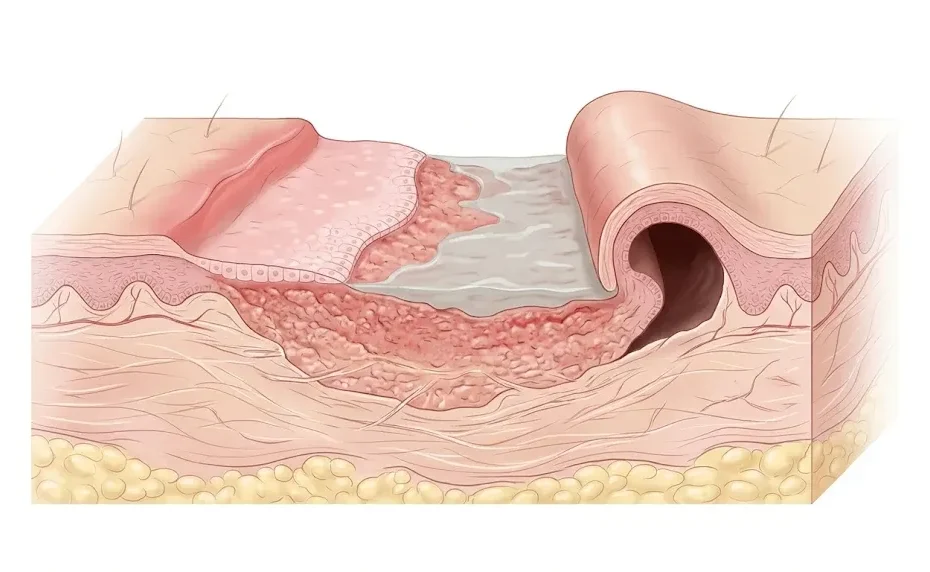
If you searched “Wondrand” expecting a product or brand, the results may have surprised you. The term is not English. It belongs to Dutch clinical vocabulary, and it describes one of the most important parts of any wound assessment: the edge.
The woundrand is not just a boundary. It is a diagnostic surface. Its color, shape, moisture, and attachment to the wound bed tell clinicians whether healing is progressing, whether infection is developing, and whether the current treatment should continue or change. This article breaks down what the term means, how professionals evaluate it, and what different wound-edge appearances actually indicate.
Quick Overview
- Wondrand = Dutch for “wound edge” or “wound margin.”
- It is a formal concept in Dutch healthcare terminology, coded under Nictiz and mapped to SNOMED CT as “Wound edge finding.”
- Wound edges are assessed for epithelialization, irritation, undermining, maceration, and other abnormalities.
- Healthy edges contract, flatten, and move toward the wound center; unhealthy edges may roll inward, undermine, or become red, warm, and swollen.
- Wound-edge protection is a recognized part of modern wound care, especially for wounds with high exudate.
- Red, warm, painful, or pus-producing edges may indicate infection and require clinical review.
What Does Wondrand Mean in Medical Dutch?
Wondrand translates literally to “wound edge” or “wound margin.” In clinical Dutch, it refers to the rim of tissue surrounding an open wound — the transition zone between damaged tissue and intact skin.
It is not a diagnosis. It is an anatomical and observational concept. Dutch healthcare systems use it as a standardized data element so that wound status can be recorded consistently across settings.
The formal definition
The Dutch healthcare information standard Nictiz defines WondRand as “the description of the condition of the edges of the wound.” The concept is coded as NL-CM-19.2.11 and mapped to SNOMED CT code 449747006 — Wound edge finding.
The standard lists five core categories for describing wound edges:
- Epithelisatie — epithelialization (new skin formation at the edge).
- Irritatie — irritation.
- Ondermijning — undermining (tissue loss beneath the edge).
- Verweking — maceration (softening from excess moisture).
- Anders — other.
This structure matters because it gives clinicians a common language. Instead of saying “the edge looks bad,” they can specify how it looks bad, which directly informs treatment.
Why the Wound Edge Matters More Than Most People Realize
A wound can look small on the surface and still be failing underneath. The edge is often the first place that failure becomes visible.
Wound healing depends on cells migrating from the wound margin across the wound bed. If the edge is healthy, that migration can proceed. If the edge is rolled inward, undermined, dried out, or chronically inflamed, the migration stalls. The wound may stay open for weeks or months despite looking “quiet.”
The edge as a progress indicator
According to wound-care education sources, evaluating the woundrand helps determine whether wound contraction and epithelialization are progressing, and whether the treatment plan needs to be reassessed. In practical terms, the edge answers a simple question: is this wound moving toward closure, or is it stuck?
That is why wound-edge assessment is not optional. It is part of a complete wound evaluation, not a cosmetic detail.
What a Healthy Wound Edge Looks Like
A healthy wound edge is usually smooth, flat, and pink to light red, with new epithelial tissue beginning to advance from the margin toward the center. As healing progresses, the edge contracts. The wound becomes smaller.
In normal healing, pain gradually decreases, and new pink or light-red skin appears at the edges. The edge should not be significantly raised, hardened, or warmer than the surrounding skin.
The direction of healing
Epithelialization starts at the woundrand in full-thickness wounds, and across the entire wound bed in superficial wounds such as abrasions. This means the edge is not passive. It is the launch point for closure.
If you are caring for a wound at home, a shrinking wound with flat, clean edges is a good sign. A wound that stays the same size for one to two weeks, or whose edges become more abnormal, warrants professional review.
What an Unhealthy Wound Edge Looks Like (and What It May Mean)
Abnormal wound edges have distinct appearances, and each points toward a different underlying problem.
This table is not a diagnostic tool. It is a guide to the vocabulary clinicians use when documenting wound status. If you notice any of these appearances, the appropriate step is clinical assessment, not self-treatment.
Signs of Infection at the Wound Edge
Infection often announces itself at the margin before it spreads. The classic warning signs are increasing redness, warmth, swelling, pain, pus, and fever.
Dutch patient information from St. Jansdal Hospital lists the key signs to watch for:
- The skin around the wound becomes red, warm, or thick.
- The wound becomes progressively more painful.
- Pus drains from the wound.
- You develop fever or malaise.
If one or more of these appear, contact a healthcare professional. Do not wait for the wound to “settle down,” especially if you have diabetes, poor circulation, or a weakened immune system.
Why edge infection is easy to miss
A low-grade infection can smolder at the woundrand without producing dramatic systemic symptoms. The edge may simply look a little more red, a little more swollen, and a little slower to heal. That subtle change is why serial assessment matters: comparing the edge today with the edge last week is more informative than a single snapshot.
How Clinicians Assess the Woundrand
Wound-edge assessment is structured. It is not a quick glance.
The core assessment domains
Clinicians evaluate the edge for:
- Epithelialization — is new skin advancing from the margin?
- Contraction — is the wound becoming smaller?
- Undermining — can a probe be passed beneath the edge?
- Maceration — is the surrounding skin softened and white?
- Irritation or inflammation — is the edge red, warm, or swollen?
- Rolling or epibole — has the edge curled inward?
These domains align with the categories in the Dutch WondRand standard and with broader wound-assessment frameworks such as the TIME model, where “E” stands for Edge (woundrand).
The TIME framework and the edge
TIME is a widely used wound-bed preparation framework:
- T — Tissue management (non-viable tissue).
- I — Infection or inflammation control.
- M — Moisture balance.
- E — Edge assessment and advancement.
Within TIME, the edge is not a footnote. It is one of the four core domains. If the edge is not advancing, the wound is not progressing, regardless of how good the wound bed looks.
Wound-Edge Protection: Why It Is Part of Modern Wound Care
Wound-edge protection is a recognized component of contemporary wound management, not an optional extra. The principle is straightforward: only a vital wound edge can support healing; a non-vital edge delays closure.
What damages the wound edge?
The edge is vulnerable to several forces:
- Excess moisture from wound exudate, sweat, urine, or stool.
- Repeated adhesive trauma from dressings.
- Friction and shear.
- Chemical irritation from cleansers or exudate.
- Pressure from positioning or devices.
Maceration is especially common. When the stratum corneum absorbs too much water, it becomes white, swollen, and fragile. The edge loses integrity, the wound may enlarge, and bacterial colonization increases.
What wound-edge protection involves
Protection strategies include:
- Using appropriate dressings that manage exudate without oversaturating the periwound skin.
- Applying skin-barrier products to the surrounding skin.
- Avoiding unnecessary adhesive trauma.
- Cleansing gently and drying the edges carefully.
- Choosing dressing materials matched to exudate level.
The goal is not to create a perfect-looking edge. It is to preserve the biological conditions that allow epithelial cells to migrate.
Practical Wound-Care Principles for Patients and Caregivers
Clinical wound management is a professional domain, but basic principles apply at home. Dutch patient guidance emphasizes clean technique, moisture balance, and early recognition of infection.
Hygiene and cleansing
Wash hands before and after wound care. Clean the wound gently — under running tap water or in the shower is acceptable for many wounds — and rinse away soap residue. Pat the wound and its edges dry with clean gauze. Do not rub.
If you have multiple wounds, clean the cleanest wound first and the dirtiest wound last. Use clean or sterile supplies and discard soiled dressings promptly.
Moisture and dressing choice
An open wound should generally be kept covered. Letting a wound dry out in open air is not recommended for most wounds. Dressings help maintain a moist environment that supports cell migration.
However, “moist” is not “wet.” Excessive exudate macerates the edge. If the skin around the wound becomes white and soft, the dressing strategy likely needs adjustment.
Nutrition and circulation
Healing requires protein and adequate nutrition. Patient information from Dutch hospitals recommends protein at each meal — dairy, cheese, meat, fish, eggs, nuts, and legumes. Smoking impairs healing and should be discussed with a clinician.
When to seek help
Seek clinical advice if:
- The wound is not smaller after one to two weeks of appropriate care.
- The edge becomes red, warm, swollen, or increasingly painful.
- Pus appears.
- You develop fever.
- The wound edge rolls inward or undermines.
These are not emergencies in every case, but they are reasons to stop watching and start assessing.
Wondrand vs. Related Terms: A Quick Clarification
Because “Wondrand” appears in Dutch clinical data standards and in patient-facing materials, it can be confused with broader wound-care terms.
- Wond = wound.
- Wondrand = wound edge.
- Wondbed = wound bed.
- Wondomgeving = skin surrounding the wound (periwound skin).
The distinction matters. The woundrand is the rim. The woundbed is the base. The periwound skin is the area around the wound, often defined as skin within about 4 cm of the edge. Each has its own assessment criteria and care needs.
Key Takeaways
- Wondrand is Dutch for wound edge or wound margin, not a product or English word.
- It is a formal concept in Dutch healthcare terminology, with defined categories: epithelialization, irritation, undermining, maceration, and other.
- Healthy edges contract, flatten, and epithelialize; abnormal edges may roll, undermine, macerate, or become inflamed.
- Red, warm, swollen, painful, or pus-producing edges suggest infection and need clinical review.
- Wound-edge protection is part of modern wound care; a non-vital edge delays healing.
- The TIME framework includes edge assessment as one of its four core domains.
FAQ
What does wondrand mean in English?
Wondrand is Dutch for wound edge or wound margin. It describes the boundary between injured tissue and surrounding intact skin. It is not an English word and does not refer to a brand or product.
Is wondrand a medical term?
Yes. It is a clinical term used in Dutch healthcare, particularly in wound care, nursing, and electronic health-record documentation. It appears in the Nictiz healthcare information standard as a formal data concept.
What does a healthy woundrand look like?
A healthy edge is smooth, flat, and pink or light red, with new skin advancing from the margin. As healing progresses, the edge contracts and the wound becomes smaller. Pain typically decreases as the edge normalizes.
What does an unhealthy wound edge look like?
Unhealthy edges may be rolled inward, undermined, white and softened (macerated), red and warm, crusted, or dark/necrotic. Each appearance points to a different problem, such as moisture imbalance, infection, poor circulation, or stalled epithelialization.
When should I worry about a wound edge?
Seek clinical advice if the edge becomes increasingly red, warm, swollen, or painful, if pus appears, if you develop fever, or if the wound stops shrinking. These signs may indicate infection or another complication requiring professional assessment.
What is wound-edge protection?
Wound-edge protection means preserving the integrity of the skin at the wound margin, especially by managing moisture, avoiding adhesive trauma, and using appropriate dressings. A vital edge is necessary for epithelialization and closure.
Conclusion
The search results you found are accurate, and they point to a very different topic from my earlier drafts. Wondrand is a Dutch clinical term for the wound edge, and the content that ranks for it is medical and educational, not commercial.
That is actually useful. It means the keyword has a clear, authoritative niche. The winning content explains the term precisely, connects it to wound-assessment frameworks, and gives readers practical signals for when an edge is healthy and when it needs attention. The article above does that, with source-based definitions and a clear boundary between patient education and clinical diagnosis.
If you are building content around “Wondrand,” lead with the definition, then earn trust through assessment detail. The term is small, but the clinical concept behind it is substantial.
You Also Like To Read: TheTechyx.com: The Newest Tech Shifts You Need to Understand Right Now (November 2026)