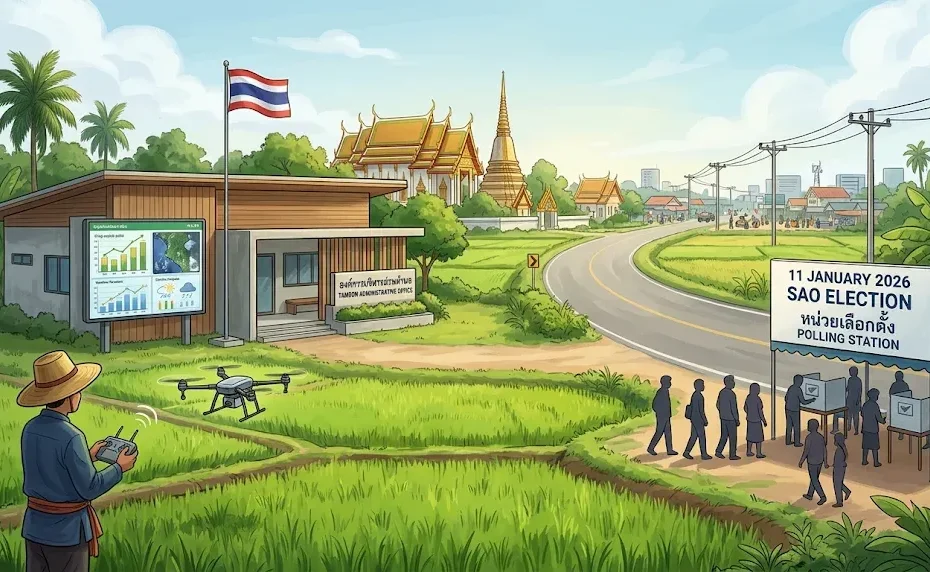
Short Intro
If you’ve ever filled in a Thai address, applied for a residence certificate, or wondered why a “subdistrict” appears on so many forms, you’ve already met the Tumbon. It’s one of the most operationally important units in Thai local governance — and 2026 is one of the most active years for it in recent memory.
This guide is updated with the newest verified information: the January 2026 SAO elections, the latest count of subdistricts, the upgrade wave converting rural SAOs into municipalities, and the digital programmes now reaching Tumbon communities. You’ll get the structure, the numbers, and the practical implications — without filler.
Quick Overview Box
- Tumbon = subdistrict: third level of Thai administration, below amphoe (district), above muban (village).
- Official spelling: Tambon (Royal Thai General System of Transcription); Tumbon is a common variant.
- Current count: approximately 7,256 Tambon across 76 provinces (excluding Bangkok’s khwaeng), according to the Department of Provincial Administration (as of 2025).
- SAO elections: held 11 January 2026 nationwide, with registration postponed in five flood-affected southern provinces.
- SAO numbers shrinking: down from 5,290 to 4,985 as SAOs are upgraded to municipalities.
- Digital push: OTOD #3 (One Tambon One Digital) launched in March 2026 and is projected to generate over 500 million baht in combined economic and social impact.
1. What Is a Tumbon? The Definition (Updated for 2026)
A Tumbon is a subdistrict — a cluster of villages grouped under one local administrative identity. It sits below the district (amphoe) and above the village (muban), and it is the level at which many public services are actually delivered: local roads, water systems, waste collection, and community health outreach.
The spelling distinction matters for search and official documents. Tambon is the correct form under Thailand’s official transcription system and is what government records and academic papers use. Tumbon is a casual variant common in travel content and everyday writing. Both refer to the same unit.
Definition in one line: A Tumbon is the subdistrict layer of Thai local government — the administrative middle ground where national policy meets village-level reality.
2. Where Tumbon Fits: Thailand’s Administrative Hierarchy
Thailand’s territorial administration stacks into four levels. The Tumbon is the third.
| Level | Thai Term | English | Approx. Count (2026) |
|---|---|---|---|
| 1 | Changwat | Province | 76 (+ Bangkok) |
| 2 | Amphoe | District | ~928 |
| 3 | Tambon / Tumbon | Subdistrict | ~7,256 (excl. Bangkok) |
| 4 | Muban | Village | ~75,000 |
The count of Tambon varies slightly by source and methodology. The Department of Provincial Administration recorded 7,256 Tambon across 76 provinces in its 2025 administrative data, while some international datasets list 7,425–7,436 subdistricts depending on how boundary changes and municipal upgrades are classified. The difference is not a contradiction — it reflects the ongoing reorganisation of the system.
Bangkok is the structural exception. The capital uses khwaeng instead of Tambon, and those khwaeng do not have the same local self-government structure as a rural SAO. Pattaya also operates under a special city administration model rather than the standard subdistrict system.
3. Who Runs a Tumbon? Kamnan, SAO, and the 2026 Election
Every rural Tumbon in Thailand is served by a Tambon Administrative Organization (TAO) — known in Thai as OrBorTor. The TAO is an elected local government body with a council and a president, responsible for budgets, local projects, and service delivery.
Alongside the TAO, the Kamnan remains the traditional subdistrict headman — chosen from among village headmen and acting as a link to the district office. The Kamnan and the TAO president are separate roles, though both operate at the Tumbon level.
The January 2026 SAO Election
This is the newest development. Thailand held SAO chief and council elections on 11 January 2026 — the first Tambon-level elections in eight years. The run-up was disrupted by severe flooding in southern Thailand in late November 2025. Candidate registration was postponed in Songkhla, Satun, Pattani, Narathiwat, and Yala from 1–5 December to 8–12 December 2025, but the 11 January election date itself remained unchanged.
The election took place against a backdrop of structural change. The number of SAOs nationwide had fallen to 4,985 by December 2025, down from 5,290, because the Ministry of Interior had upgraded a series of SAOs to municipality status. In upgraded areas, full-term SAO elections could not be held until new electoral districts were drawn and approved — a process that takes at least a month, followed by a further 45 days before voting. Those upgraded areas are expected to hold their elections in early April 2026.
According to the International IDEA election database, the January 2026 vote was held under difficult conditions but maintained its integrity, with the Election Commission emphasising the need for credible local elections despite the flood crisis.
4. The Upgrade Wave: Why SAO Numbers Are Shrinking
The drop from 5,290 to 4,985 SAOs is not a sign of the Tumbon fading. It’s a sign of urbanisation and administrative maturity.
When a Tumbon grows in population and revenue, it can be upgraded to a municipality (thesaban). Thailand recognises three tiers: subdistrict municipality (thesaban tambon), town municipality (thesaban mueang), and city municipality (thesaban nakhon). Each tier requires higher population and revenue thresholds than the last.
The upgrade is formalised by ministerial announcement and takes effect on a specified date. For example, Sa-Or Subdistrict Administrative Organization in Sa Kaeo province was officially elevated to Sa-Or Subdistrict Municipality effective 28 November 2025. Once upgraded, the SAO is dissolved and the municipality takes over local services. The new municipality must redraw electoral districts — a process that requires public consultation and Election Commission approval — before it can hold its first municipal elections.
This upgrade path is a core feature of Thailand’s system, not an anomaly. Between 2009 and 2014 alone, 703 SAOs became Tambon municipalities. The 2025–2026 wave is the latest phase of that long-term trend.
5. The Digital Tumbon: OTOD #3 and Measurable Impact
The other major 2026 development is digital. Thailand’s “One Tambon One Digital” (OTOD) programme has moved from pilot to results.
OTOD Season 3 (OTOD #3) was launched on 17 March 2026 by the Digital Economy Promotion Agency (DEPA) in partnership with the Department of Agricultural Extension. The programme targets digital agriculture: it helps farmers adopt agricultural drones, smart tractors, and IoT-based greenhouse management to increase income and reduce costs.
The results are now public. By August 2026, DEPA reported that OTOD #3 had not only reached its beneficiary targets but had driven a measurable transition from traditional farming to data- and technology-based agriculture. The project is projected to generate more than 500 million baht in combined economic and social impact.
This matters for anyone dealing with Tumbon administration because the Tumbon is the delivery unit. The programme is organised around subdistrict communities, and the local SAO or municipality office is often the first point of contact for farmers enrolling in digital training or receiving equipment. The Tumbon office is no longer just a place for residence letters — it is becoming a node in a national digital service network.
6. Decentralisation in 2026: Stagnation and Incremental Reform
The policy environment around Tumbon governance is mixed. Academic analysis published in 2026 concludes that Thailand’s decentralisation has stagnated for over two decades, with local authorities operating under dense central supervision and tight fiscal controls. Despite constitutional guarantees of local self-government, fiscal, administrative, and personnel powers remain concentrated in Bangkok.
But incremental reform is happening. In August 2026, the Ministry of Interior held a seminar on constitutional law and decentralisation, where the Deputy Minister emphasised that local government is “closest to the people” and outlined a proposed local tax bill that would allow citizens to direct a portion of their annual tax payments to their preferred local authority — effectively creating a performance incentive for local administrations.
A royal decree issued in August 2026 also changed the electoral framework for local bodies. Mayors, subdistrict councils, SAO councils, and provincial administrative organisations now serve four-year terms with no term limits, and the minimum age for members was reduced from 35 to 25. This directly affects how Tumbon-level councils will operate and who can run for them.
In May 2026, opposition figures met with the Subdistrict Administrative Organization Association to discuss boosting local revenue and studying the establishment of a dedicated Ministry of Local Administration — a sign that the structural debate around Tumbon governance is far from settled.
The Collected Essays on the Development of Subdistrict Administrative Organizations, published in December 2025, frames the 2026 election as a timely opportunity to reassess the SAO’s role amid changing political and administrative expectations.
7. Practical Impact: Addresses, Immigration, and Property
For anyone living in or doing business in Thailand, the Tumbon is not abstract. It appears on:
- Thai addresses: the Tumbon name is a required line, often abbreviated “T.” before the subdistrict.
- Immigration paperwork: the TM30 residence notification and residence certificates include the Tumbon.
- Property and land documents: Tumbon boundaries are relevant to land-use planning and local permits.
- Local services: the SAO or municipality office is the first point of contact for waste contracts, local roads, and community approvals.
The upgrade wave means some addresses that were in an SAO jurisdiction in 2025 will be in a municipality in 2026. That change can affect which office handles a permit, which local plan applies, and how local fees are structured.
Real-world example: A business operating in a subdistrict that was upgraded from SAO to thesaban tambon in late 2025 will now deal with a municipal office instead of the SAO for local licensing and service requests. The Tumbon name may remain the same on the address, but the governing authority has changed.
8. Common Confusions (2026 Edition)
Tumbon vs. Tambon. Same unit. Tambon is official; Tumbon is a variant. Use Tambon in formal writing.
Tumbon vs. Amphoe. An amphoe is a district — a group of Tambon. The district office sits above the subdistrict in the hierarchy.
Tumbon vs. Muban. A muban is a village. A Tambon contains multiple muban.
Tumbon vs. Bangkok’s Khwaeng. Bangkok’s khwaeng are at the same level but are not Tambon and do not have the same local self-government structure.
SAO vs. Municipality. An SAO is the local government for a rural Tambon. A municipality (thesaban) is the local government for an upgraded, more urbanised Tambon. The upgrade is a change in status, not a change in the Tumbon’s identity.
Key Takeaways Box
- A Tumbon is a subdistrict — the third level of Thai administration, between district and village.
- The official spelling is Tambon; Tumbon is a common variant. Both appear in search and everyday use.
- SAO elections were held on 11 January 2026, with flood-related registration delays in five southern provinces.
- SAO numbers have fallen to 4,985 as more subdistricts are upgraded to municipalities.
- OTOD #3 is delivering measurable results, with over 500 million baht in projected economic and social impact from digital agriculture in Tumbon communities.
FAQ
What is a Tumbon in Thailand?
A Tumbon (officially Tambon) is a subdistrict — the administrative layer between the district (amphoe) and the village (muban). It is the level at which many local services are delivered and at which SAO or municipal elections are held.
What is the difference between Tumbon and Tambon?
They refer to the same unit. Tambon is the official spelling under Thailand’s standard transcription system. Tumbon is a casual variant common in travel and everyday writing.
When were the 2026 Tambon elections held?
The SAO chief and council elections were held nationwide on 11 January 2026. Registration was postponed in Songkhla, Satun, Pattani, Narathiwat, and Yala due to flooding, but the election date itself was maintained.
Why are there fewer SAOs in 2026?
The number of SAOs fell to 4,985 because the Ministry of Interior upgraded a series of SAOs to municipality status. Upgraded areas must redraw electoral districts before holding new municipal elections.
What is OTOD #3?
OTOD #3 (One Tambon One Digital Season 3) is a 2026 digital agriculture programme that brings drones, smart tractors, and IoT systems to Tumbon communities. It is projected to generate over 500 million baht in economic and social impact.
Does the Tumbon affect immigration?
The Tumbon appears on immigration paperwork such as the TM30 and residence certificates, but it does not determine which immigration office handles you — that is set at province and district level.
Conclusion
The Tumbon is the quiet layer of Thai governance that most people only notice when they need a document signed or a local road fixed. But in 2026, it is more active than it has been in years: elections have reset local leadership, upgrades are redrawing the map of who governs what, and digital programmes are giving subdistrict offices a new role in the rural economy.
If you understand the Tumbon — where it sits, who runs it, and what is changing — you understand how Thailand actually works on the ground. And in a year of transition, that knowledge is more useful than ever.
You Also Like To Read: Wondrand: The Dutch Medical Term for Wound Edges and What It Reveals About Healing