You’ve probably seen the word appear in a strange corner of the internet. Maybe a blog called it a hidden beach. Maybe a social post claimed it’s an ancient practice. Maybe a search result described it as a new digital expression. None of that is true.
Tsunaihaiya is something far more specific—and far more interesting. It’s a real jewelry label with a real founder, a real cultural story, and a real (if small) place in the collectors’ market. This guide separates the facts from the noise and gives you the most current, verified information available.
Quick Overview
- What it is: A Japanese jewelry brand founded in 2012 by Yusuke Kuwano and San Carlos Apache sculptor Craig Dan Goseyun.
- What the name means: In the San Carlos Apache language, “Tsunai Haiya” evokes “the land where the sun rises”—a poetic reference to Japan.
- What makes it distinctive: Handmade sterling silver pieces that fuse Native American stamping and carving techniques with Japanese precision and color sensibility.
- What’s new: No official new collection has been announced recently, but authenticated pieces continue to appear on the resale and collector market in 2025–2026.
- What to watch out for: A wave of low-quality SEO pages inventing meanings for the term; none are supported by the brand’s actual history.
What Is Tsunaihaiya, Exactly?
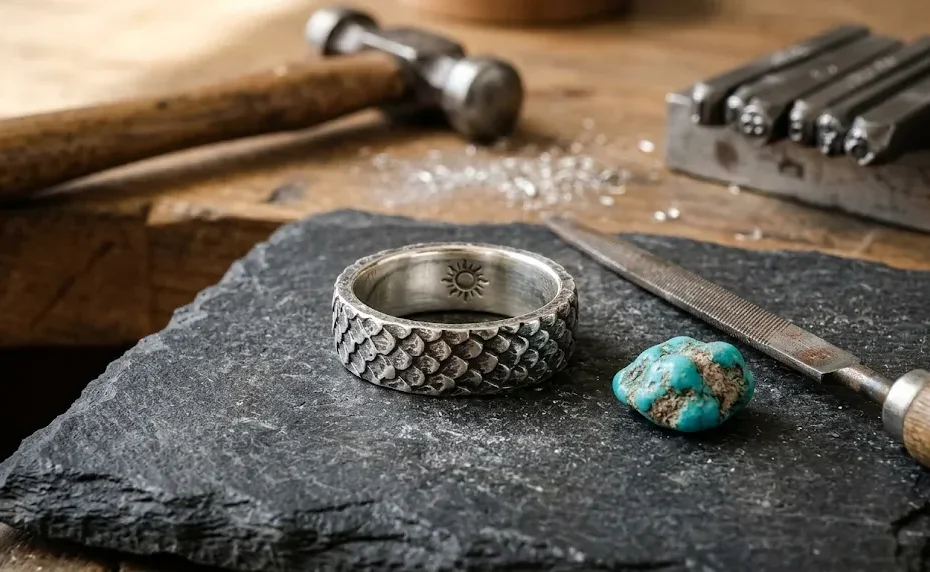
Definition: Tsunaihaiya (often written as Tsunai Haiya) is a small-batch jewelry atelier established in 2012. It produces rings, bangles, and accessories in sterling silver, often featuring snake, sun, and deer motifs. Every piece is handmade, so no two are identical.
The brand operates in the space between two craft traditions. Its design language draws from the Native American jewelry of the American Southwest—stamping, repoussé, and heavy silverwork—while its finish and attention to detail reflect Japanese metalworking discipline.
This isn’t a mass-market label. You won’t find it in a shopping mall. It circulates through specialist select shops, occasional online drops, and a quiet but persistent resale market.
Who Founded Tsunaihaiya?
The story starts with a Japanese artist who moved to Santa Fe, New Mexico, to study metalwork. Yusuke Kuwano enrolled at the Institute of American Indian Arts (IAIA), an accredited institution dedicated to contemporary Native American art. He studied under Navajo jeweler Michael Roanhorse and graduated as the top student in his department.
In 2012, Kuwano partnered with Craig Dan Goseyun, a sculptor from the San Carlos Apache tribe. Together they launched Tsunai Haiya. The partnership wasn’t a marketing gimmick; it was a genuine cross-cultural collaboration between two makers who shared a respect for Southwest metal traditions.
That origin matters because it explains the brand’s visual signature. The silver isn’t polished to a mirror shine. It carries the marks of the hammer, the stamp, and the file—evidence of the hand that made it.
Why Does the Name Mean “Sunrise”?
The name is often translated as “sunrise” or “the land of the rising sun.” This is not a coincidence. In San Carlos Apache, the concept connects to the Sunrise Ceremony, a foundational rite of passage for young Apache women. The Smithsonian’s National Museum of the American Indian has documented the Western Apache Sunrise Ceremony as a central cultural practice, and the symbolism of dawn—renewal, emergence, beginning—carries real weight.
For Kuwano, the name was a way to honor both sides of the collaboration: the Apache language that gave the brand its sound, and the Japanese identity that gave it its home. It’s a rare example of a brand name that actually means something rather than being manufactured by a focus group.
What Makes Tsunaihaiya Jewelry Different?
Three things separate this label from the average silver accessory.
First, the technique. Kuwano works with stamping, carving, and hand-finishing methods associated with Southwestern Native American jewelry. The snake rings, for example, are built from multiple stamped segments that create a three-dimensional scale pattern—a process that cannot be replicated by a machine.
Second, the color palette. Traditional Apache jewelry often uses peridot, turquoise, and coral. Tsunaihaiya incorporates these tones selectively, but filters them through a Japanese sensitivity to muted, layered color. The result feels earthy without being costume-like.
Third, the scarcity. Because everything is handmade by a small team, production is limited. A piece you see today may not be available next month. That scarcity is not artificial; it’s a direct consequence of the production method.
| Feature | Typical Silver Jewelry | Tsunaihaiya |
|---|---|---|
| Production | Cast or machine-stamped | Hand-fabricated, one-of-one |
| Design source | Trend-driven | Apache and Japanese craft traditions |
| Finish | High polish, uniform | Textured, mark-forward |
| Availability | Continuous | Limited drops and resale |
| Price range (approx.) | $30–$150 | $150–$500+ |
The “Newest” Information: What’s Happening in 2025–2026
Here’s where the search results get messy. If you search for “Tsunaihaiya 2026,” you’ll find blogs claiming it’s a beach destination, a digital trend, or an ancient wisdom tradition. Those pages are not credible. They are keyword-driven content with no connection to the actual brand.
The verified recent activity is quieter and more concrete.
- Resale listings have appeared on Japanese marketplaces in 2025, including Rakuten listings for authenticated rings priced around ¥24,200 (roughly $160–$180 USD at recent exchange rates). These are secondary-market sales, not new brand releases.
- Buy-back and appraisal services in Japan have continued to handle Tsunaihaiya pieces, suggesting that the brand retains enough collector interest to justify a resale infrastructure.
- No new official collection has been announced for 2026. The brand’s output remains small-batch and sporadic. If you want a new piece, your realistic options are select retailers or the resale market.
This is not a brand that chases seasonal drops. It operates on a different rhythm—one piece at a time, for a small audience that values the craft over the calendar.
How to Identify Authentic Tsunaihaiya Pieces
Because the brand is niche, counterfeits are less common than with luxury watches or designer handbags. But misattribution is a real problem. Here’s what to check.
- Look for the sun mark. Authentic pieces often carry a small engraved sun motif, a reference to the brand’s name.
- Inspect the stamping. The texture should be irregular and hand-cut, not uniform and machine-repeated.
- Check the weight. Sterling silver pieces have a solid, substantial feel. If it feels hollow or unusually light, be skeptical.
- Ask for provenance. Reputable resellers will provide photos of the maker’s mark, the interior finish, and any original packaging.
- Compare against documented pieces. Look for archived listings from established Japanese select shops. The proportions and finish should match.
If a listing uses the name but shows a cast, high-polish ring with no visible handwork, it’s almost certainly not Tsunaihaiya.
Tsunaihaiya vs. the Misinformation Problem
Why does so much false information exist about this term? The answer is boring: search volume. “Tsunaihaiya” is a distinctive string of letters, which makes it attractive to content farms. They build pages that answer generic questions—What does it mean? How do you use it?—without knowing what the term actually refers to.
The result is a search landscape where a real jewelry brand is buried under pages about imaginary beaches and invented traditions. For readers, the takeaway is simple: if a source doesn’t mention Yusuke Kuwano, Craig Goseyun, or jewelry, it’s not a reliable source about Tsunaihaiya.
Is Tsunaihaiya Worth Collecting in 2026?
For a certain kind of collector, yes. The brand sits at the intersection of three things people value right now: handcraft, cross-cultural storytelling, and scarcity. Pieces are not inexpensive, but they’re also not priced like blue-chip art. They occupy a middle ground—accessible enough for a first serious jewelry purchase, distinctive enough to hold attention.
The care routine is straightforward. Sterling silver tarnishes; a soft polishing cloth will restore the shine without stripping the intentional texture. Avoid ultrasonic cleaners, which can dull the hand-finished surface. Store pieces separately to prevent scratches.
And if you’re buying on the resale market, prioritize documentation over urgency. A verified piece with a clear history is worth more than a “rare find” with no provenance.
Key Takeaways
- Tsunaihaiya is a jewelry brand, not a place, practice, or digital trend.
- It was founded in 2012 by Yusuke Kuwano and Craig Dan Goseyun.
- The name references Apache language and the symbolism of sunrise.
- Authentic pieces are handmade, textured, and scarce.
- Recent activity is concentrated in the resale market, not new collections.
FAQ
What is Tsunaihaiya?
Tsunaihaiya is a Japanese jewelry brand founded in 2012. It makes handmade sterling silver pieces that combine Native American Southwestern techniques with Japanese metalwork.
Is Tsunaihaiya a real brand or a hoax?
It’s a real brand with a documented founder and a verifiable origin story. The confusion comes from unrelated SEO pages that use the term for other topics.
What does the name Tsunaihaiya mean?
In the San Carlos Apache language, it is commonly translated as “sunrise” or “the land where the sun rises,” a reference to Japan.
Where can I buy Tsunaihaiya jewelry in 2026?
The most reliable sources are specialist Japanese select shops and authenticated resale listings. No major global retailer carries the brand.
How can I tell if a Tsunaihaiya piece is authentic?
Look for hand-stamped texture, the engraved sun motif, solid sterling silver weight, and clear provenance from a reputable seller.
Is Tsunaihaiya worth investing in?
It’s a collectible craft brand, not a financial asset. Buy it for the design and craftsmanship, not for speculative returns.
Conclusion
The internet has a way of flattening strange, specific things into generic noise. Tsunaihaiya is a case study in that process—a real collaboration between two makers, buried under pages that never bothered to find out what it was.
If you came here looking for the truth, here it is: a small jewelry brand, made by hand, carrying a name that means something. That’s rarer than any trend. And it’s worth remembering the next time a search result tries to tell you otherwise.
You Also Like To Read: Wondrand: The Dutch Medical Term for Wound Edges and What It Reveals About Healing