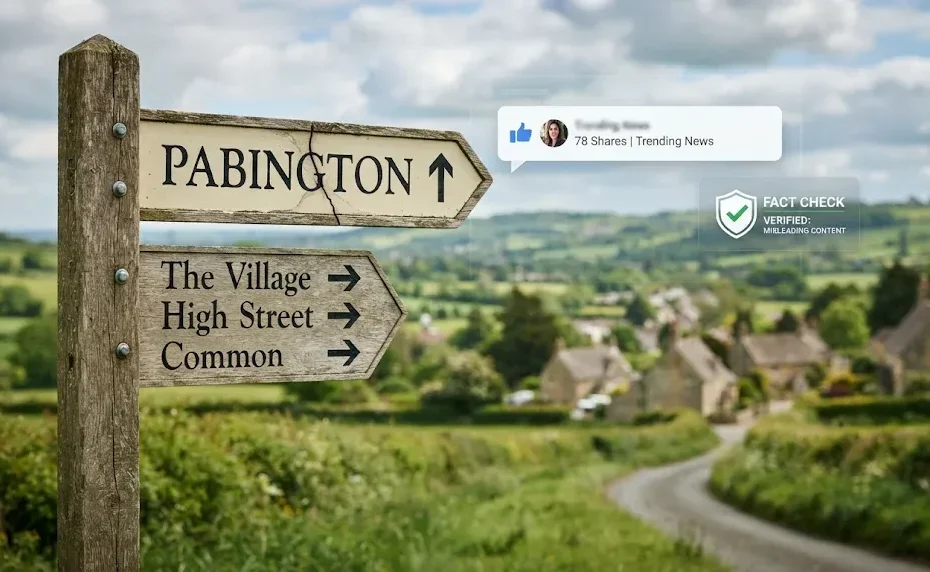
Pabington isn’t a real place. It never was. In 2026, the word has settled into a strange middle ground: too famous to ignore, too fake to visit. This guide cuts through the misinformation, separates Pabington from the real village of Piddington, and explains why a made-up word keeps winning the internet.
Quick Overview (2026 Update)
- Pabington remains absent from every official geographic database, including the U.S. Board on Geographic Names.
- The term is not a lost Saxon village, a West London district, or a secret neighbourhood. Those claims are false.
- Pabington is a viral internet label with no fixed meaning, remixed across TikTok, memes, and creative writing.
- It is routinely confused with Piddington, a real Oxfordshire village that dominated UK news in late 2026.
- Use Pabington for creative projects only. Never cite it as a location.
Is Pabington a Real Place in 2026?
No. And the evidence is not ambiguous.
The U.S. Board on Geographic Names runs the Geographic Names Information System (GNIS), the federal database of recognised place names. Pabington does not appear there as a town, village, or landmark. A .gov search for the term returns results for Piddington, Abington, and Podington — but nothing for Pabington.
So where does the confusion come from? In 2026, a handful of websites began describing Pabington as a “historic district in West London” with a “famous railway station” and “Saxon origins”. None of that is true. No railway station, no district, no council record, no historical archive supports the claim. It is misinformation dressed up as local history.
Definition: Pabington is a fabricated or viral term that mimics English place-name patterns. It has no official geographic status, no confirmed origin, and no fixed meaning.
Why Does Pabington Sound So Real?
Because English place names follow a formula — and Pabington follows it perfectly.
The suffix “-ton” comes from the Old English word tūn, meaning a farm, enclosure, or village. Oxford’s Anglo-Saxon teaching resources confirm that ton or tun appears in hundreds of real place names across England. That’s why Pabington feels familiar before you even question it.
There’s also the Paddington effect. Paddington is a real London district and a globally famous fictional bear. Pabington sits one letter away. Collins lists Paddington as a genuine London place name, and Babington as an established surname. Pabington borrows credibility from both without belonging to either.
There’s one small historical wrinkle. Ancestry lists a single Pabington family in Kent in the 1891 UK census. That points to a rare surname, not a lost village. It is the closest thing to a documented history the word has — and it is nowhere near enough to make it a real place.
How Did Pabington Become a Trend?
Pabington didn’t spread because it meant something. It spread because it meant nothing — and that gave people room to invent.
In 2026, the trend is still active. Fresh explainers appeared in January, February, April, and May 2026, showing the term has not settled into a dead meme cycle. GenZee Mag described it as “a modern internet-generated term that has gained attention through curiosity, social sharing, memes, and online discussion”.
The pattern is predictable. A word sounds official. Nobody can pin it down. Curiosity does the sharing. Pabington rewards that curiosity because every search leads to a slightly different answer — and that keeps people talking.
Pabington vs. Piddington: The Confusion Explained (2026 Update)
This is where the story gets messy — and where 2026 changed everything.
Piddington is real. It is a village of roughly 350 people in Oxfordshire, about 15 miles from Oxford. In September 2026, residents voted 285 to 26 in a symbolic referendum to “secede” from the UK in protest against government plans to house up to 1,256 male asylum seekers at the nearby MoD Bicester site.
By November 2026, Communities Secretary Angela Rayner granted full planning permission for the site, using an Urgent Crown Development application. The decision triggered a promised legal challenge from the parish council. BBC News reported that the government received 3,177 representations against the plan and one in support.
| Feature | Pabington | Piddington |
|---|---|---|
| Status | Viral internet term | Real Oxfordshire village |
| Population | None (not a place) | ~350 residents |
| Official records? | No | Yes — council, news, government files |
| In the news in 2026? | As a trend and misinformation target | As the site of a national asylum controversy |
| Best use | Memes, fiction, usernames | News, local information, formal writing |
One letter makes the difference between a meme and a real news story. If you mean the village, write Piddington. If you mean the trend, write Pabington. Never mix them up in the same sentence.
How to Use Pabington Without Spreading Misinformation
Pabington is harmless in the right context and damaging in the wrong one. Here’s the practical split.
Where it works
- Creative writing. It’s a ready-made fictional village name. No explanation needed.
- Usernames and handles. Memorable, clean, and slightly odd in a good way.
- Social captions and memes. Open-ended words invite comments because people want to decide what they mean.
- Brand brainstorming. Distinctive — but check trademarks first, because it sits close to Paddington and Babington.
Where it doesn’t
- Formal documents. If clarity matters, use a recognised name or a plain description.
- Travel planning. You cannot visit Pabington. It isn’t anywhere.
- News and research. Do not present it as a real location. The “West London historic district” claim is false, and repeating it spreads misinformation.
- Factual claims about Saxon history. The “estate of Padda” etymology attached to Pabington online is invented. No academic source supports it.
The rule is simple: give Pabington one job — meme, setting, or persona — and keep it out of anything that requires factual accuracy.
What Does the Future Hold for Pabington?
Trends like this usually follow a predictable arc. They spike, get explained, then either settle into niche use or fade.
Pabington is in the “explained” phase. Major search results now include guides that clarify what it is and isn’t. That’s a sign the term is maturing. It may never disappear completely, because it’s useful as a creative label. But its days as a genuine mystery are numbered.
The more interesting question is what it tells us about how language spreads in 2026. A word doesn’t need a dictionary entry to go viral. It needs to feel plausible. Pabington is proof that familiarity, not truth, is often what makes a term travel — and that the internet will fill a semantic vacuum with myths if nobody checks the facts.
Key Takeaways
- Pabington is not a real place — it appears in no official geographic database.
- The “West London historic district” and “Saxon village” claims are false.
- It sounds real because of the Old English -ton suffix and the Paddington effect.
- Piddington is the real Oxfordshire village in the 2026 news — not Pabington.
- Use Pabington for creative purposes only. Verify before you cite.
FAQ
Is Pabington a real town in England?
No. Pabington does not appear in GNIS or any official UK geographic database. It is a viral term that mimics an English village name but has no physical location, no council, and no residents.
Where did the word Pabington come from?
There is no confirmed origin. It emerged online and spread through social media because it sounds familiar and leaves room for interpretation. The only documented historical trace is a rare surname in the 1891 UK census.
Is Pabington the same as Paddington?
No. Paddington is a real London district and a famous fictional bear. Pabington is a separate term that sounds similar. The resemblance is one reason it spreads, but the two are not connected.
Why are people confusing Pabington with Piddington in 2026?
Piddington is a real Oxfordshire village that voted symbolically to “secede” in September 2026 and had asylum centre plans approved in November 2026. The names look and sound alike, so some readers mix them up. They refer to completely different things.
Is Pabington a slang term with a hidden meaning?
No. It has no fixed slang definition. People use it as a meme, a fictional place, a username, or a creative label. The meaning depends entirely on context.
Can I use Pabington as a brand name?
You can, but do a trademark search first. The name sits close to Paddington and Babington, and similarity to existing marks is a common reason applications fail. Treat it as a creative starting point, not a safe legal bet.
Conclusion
Pabington is a word that thrives on ambiguity. It looks like a place, sounds like a place, and isn’t one. In 2026, that ambiguity has spawned a second problem: misinformation. Websites have invented a fake West London history for a word that has no history at all.
If you take one thing away, make it this: a name can feel real without being real, and a trend can spread without being true. Pabington is a reminder to check before you cite — and to keep the meme separate from the facts. The real story in 2026 belongs to Piddington, a village that actually exists, actually voted, and actually made headlines. Pabington, by contrast, is a ghost on a signpost. Enjoy the word. Don’t book a trip.
You Also Like To Read: Tracqueur in 2026: The Complete Guide to GPS Trackers, Laws, and Smart Choices