What Does “Logistics” Actually Cover?
Logistics is the engine room behind every product you buy. It’s the planning, moving, storing, and tracking of goods from where they’re made to where they’re needed.
The Council of Supply Chain Management Professionals (CSCMP) puts it plainly: logistics is the part of supply chain management that controls the forward and reverse flow and storage of goods, services, and information between origin and consumption. That definition matters because it already hints at the two biggest splits in the field—forward versus reverse, and goods versus information.
But here’s the catch: logistics isn’t a single job. A factory receiving steel coils, a retailer shipping sneakers to customers, and a repair center processing returned laptops are all doing logistics—but they’re doing very different kinds of work.
That’s where logistics business category classification becomes useful. It gives you a shared language for separating those activities so you can plan, budget, and outsource them properly.
Definition: Logistics classification is the practice of grouping logistics activities by a shared characteristic—direction of flow, business function, who performs the work, or environmental impact—so they can be managed and discussed with clarity.
The Direction-Based Split: Inbound vs. Outbound
The most intuitive way to classify logistics is by which way the truck is pointing.
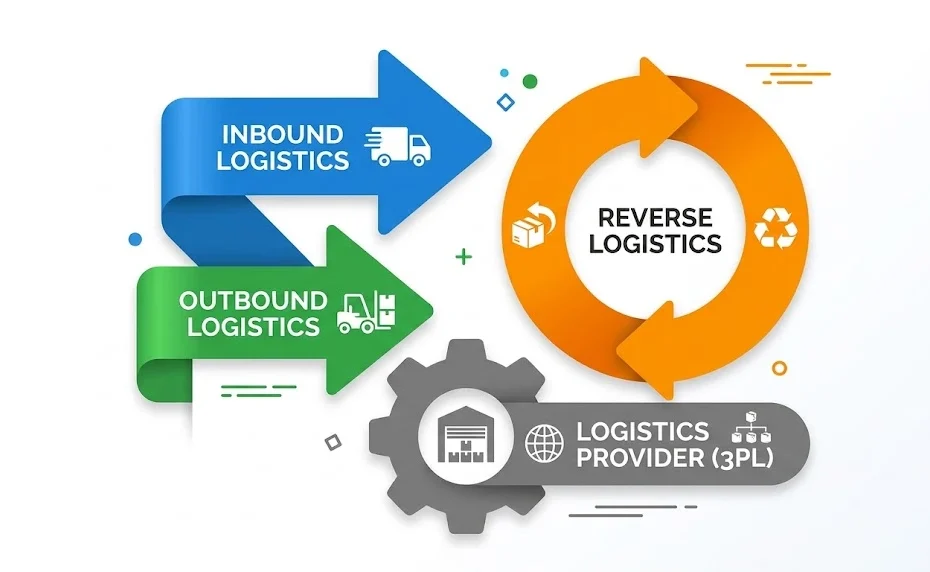
Inbound logistics is everything that brings materials and supplies into your operation. Think supplier selection, purchase order tracking, freight consolidation, customs clearance for imported components, and receiving dock scheduling. If you run a bakery, inbound logistics is the flour, butter, and packaging arriving before sunrise.
Outbound logistics is the mirror image: finished goods leaving your operation and reaching the customer. Order fulfillment, picking and packing, last-mile delivery, and returns pickup all sit here. For an online retailer, outbound logistics is the box on the doorstep.
Why does the distinction matter? Because inbound and outbound problems are rarely the same. Inbound failures usually trace back to supplier reliability, lead-time variability, or port delays. Outbound failures more often involve warehouse accuracy, carrier capacity, or customer-facing delivery promises. Treating them as one blob hides the real bottlenecks.
A simple example: a furniture manufacturer might have stable inbound flows of timber and hardware but chaotic outbound flows because bulky items are hard to deliver and often arrive damaged. The classification tells you where to invest—packaging engineering and carrier selection, not supplier management.
Reverse Logistics: When Goods Come Back
Forward logistics gets the glory. Reverse logistics pays the bills in the background.
Reverse logistics covers the movement of goods backward through the supply chain—returns, repairs, warranty replacements, recalls, recycling, and disposal. The CSCMP definition explicitly includes reverse flow, which tells you it’s not an afterthought in the professional standards.
E-commerce has made this category impossible to ignore. A customer ordering three sizes of the same jacket and returning two is a reverse logistics event. So is a retailer sending unsold seasonal stock to an outlet, or a manufacturer recovering components from defective units.
The operational challenges are different from forward logistics. Returns are unpredictable, often low-volume per SKU, and require inspection and sorting before a decision can be made: restock, repair, refurbish, recycle, or scrap. That’s why companies that treat reverse logistics as “just returns” often find it quietly eating their margins.
Rule of thumb: If a product is moving opposite to the original sale direction, it’s reverse logistics—even if it’s being moved for a good reason like repair or donation.
Functional Classifications: Procurement, Production, Distribution, Disposal
Another common framework groups logistics by the business function it serves. This lens is especially useful inside larger organizations where different departments own different logistics budgets.
Here’s how the main functional categories break down:
| Category | Core Question It Answers | Typical Activities |
|---|---|---|
| Procurement logistics | How do we get inputs reliably? | Supplier coordination, inbound transport, receiving, inbound quality checks |
| Production logistics | How do we keep the line moving? | Internal material handling, work-in-progress movement, line-side replenishment |
| Distribution logistics | How do finished goods reach buyers? | Warehousing, order picking, outbound transport, channel delivery |
| Disposal logistics | How do we handle waste and end-of-life goods? | Scrap removal, recycling coordination, compliant disposal, packaging waste |
Procurement logistics is tightly linked to inventory strategy. If a factory runs a just-in-time model, procurement logistics has to be precise—late materials stop the line. If the factory keeps buffer stock, procurement logistics can tolerate more variability but ties up cash in inventory.
Distribution logistics is where most customer experience is won or lost. A perfect product that arrives three days late and damaged is, from the customer’s perspective, a logistics failure.
Disposal logistics is the least glamorous category but increasingly regulated. Packaging waste, hazardous materials, and electronic waste all require documented handling. Skipping this category doesn’t make the problem disappear—it just moves the risk to your compliance team.
Who Moves the Freight? 1PL, 2PL, 3PL, and 4PL
Direction and function tell you what is happening. Provider classification tells you who is doing it.
This is where terms like third-party logistics (3PL) and fourth-party logistics (4PL) enter the conversation. They’re not types of freight—they’re types of service arrangements.
1PL means the shipper handles its own logistics. A farm delivering its own produce to a local market is a 1PL operation. 2PL means a asset-based carrier provides the transport—think a trucking company or a shipping line. 3PL means an outside provider manages and executes multiple logistics functions, often including warehousing, transportation, and order fulfillment. 4PL goes a step further: the provider orchestrates the entire supply chain, coordinating multiple 3PLs and other partners without necessarily owning the physical assets.
The practical difference is control versus capability. A 3PL gives you operational capacity without capital investment. A 4PL gives you strategic coordination without building an internal logistics department. A 1PL gives you total control but demands total capability.
Most growing businesses don’t jump straight from 1PL to 4PL. They typically start by outsourcing a single pain point—say, outbound parcel shipping—and expand the relationship as trust and volume grow.
Green Logistics and the Sustainability Shift
Logistics has a carbon problem, and the industry knows it. Freight accounts for a significant share of transport emissions, and customer expectations are shifting fast.
Green logistics is the classification that puts environmental impact at the center of logistics decisions. It’s not a separate mode of transport—it’s a lens applied across inbound, outbound, reverse, and distribution activities. Route optimization, modal shift (road to rail or water), packaging reduction, and carrier emissions benchmarking all fall under this umbrella.
The U.S. Environmental Protection Agency runs a voluntary program called SmartWay that helps shippers and carriers measure, benchmark, and improve freight sustainability. It’s a useful reference point because it shows how classification and measurement go hand in hand: you can’t manage what you haven’t categorized.
For beginners, the key insight is that green logistics isn’t just a compliance cost. Fuel efficiency, load consolidation, and route density are classic cost-reduction levers. Many “green” moves are also “lean” moves—they cut emissions and spend at the same time.
For professionals, the challenge is data. Emissions factors vary by mode, carrier, and load. A classification system that doesn’t capture those variables will produce a sustainability report that looks tidy but tells you nothing actionable.
How to Choose the Right Classification for Your Situation
You don’t need to memorize every framework. You need to pick the lens that matches the decision in front of you.
If you’re diagnosing a cost problem, start with the direction-based split. Is the pain in inbound (supplier delays, receiving inefficiency) or outbound (carrier rates, delivery failures)? That single question narrows the investigation dramatically.
If you’re restructuring a department, use the functional lens. Procurement, production, distribution, and disposal each have different KPIs and different skill requirements. Mixing them under one manager often creates accountability gaps.
If you’re evaluating outsourcing, use the provider lens. Decide whether you need asset capacity (2PL), operational management (3PL), or strategic orchestration (4PL). The wrong provider model creates friction—a 3PL can’t fix a supply chain design problem, and a 4PL may be overkill for a single-warehouse operation.
If you’re responding to customer or regulatory pressure, add the green lens. It cuts across all other categories and forces you to measure what you might otherwise ignore.
A classification isn’t a cage. It’s a map. The map is useful only if it helps you get somewhere.
Common Misunderstandings About Logistics Classification
A few myths are worth clearing up.
Myth 1: There’s one official list. There isn’t. Different professional bodies, textbooks, and software vendors use different categories. CSCMP provides a foundational definition, but it doesn’t mandate a single taxonomy. The right list is the one that fits your decision context.
Myth 2: 3PL and 4PL are types of logistics work. They’re not. They describe who performs the work and how much of the supply chain they coordinate. A company can outsource inbound logistics to a 3PL and still manage outbound logistics in-house—that’s a mixed model, and it’s common.
Myth 3: Reverse logistics is just returns. Returns are the most visible part, but repair loops, warranty processing, recycling, and recall management are all reverse logistics. Treating it as a customer-service afterthought usually leads to higher costs and weaker compliance.
Myth 4: Green logistics is only for large companies. Small shippers can benefit from carrier selection, load consolidation, and route planning just as much as multinationals. The tools scale down more than most people expect.
Key Takeaways
- Classification is a decision tool, not trivia. Use it to separate problems, assign ownership, and choose the right service model.
- Direction (inbound, outbound, reverse) is the fastest way to locate a logistics bottleneck.
- Function (procurement, production, distribution, disposal) clarifies departmental responsibilities and KPIs.
- Provider level (1PL–4PL) describes outsourcing depth, not the physical work itself.
- Sustainability cuts across every category—and often overlaps with cost reduction.
FAQ
What is the simplest way to classify logistics activities?
Start with direction: is the goods flow inbound, outbound, or reverse? That single question separates most operational problems into manageable buckets before you add functional or provider layers.
Is 3PL the same as outsourcing logistics?
Not exactly. 3PL is a specific outsourcing model where a provider manages multiple logistics functions. A company can outsource a single transport lane to a 2PL carrier without using a full 3PL arrangement.
What’s the difference between reverse logistics and returns management?
Returns management is one slice of reverse logistics. Reverse logistics also covers repairs, recalls, recycling, and disposal—anything moving opposite to the original sale direction.
Do I need a 4PL if I already use a 3PL?
Only if coordination across multiple providers is the bottleneck. A 4PL adds value when you’re juggling several 3PLs and need one integrator to design and manage the whole network. For simpler operations, a 3PL is usually enough.
How does green logistics fit into the other categories?
It’s a cross-cutting lens, not a separate bucket. You can have green inbound, green outbound, green reverse, and green distribution. The classification stays the same; the decision criteria expand.
Where can I find a reliable definition of logistics?
The CSCMP FAQ provides a widely cited professional definition that covers forward and reverse flows.
Conclusion
Logistics gets messy when everything is called “logistics.” A return, a supplier delivery, a warehouse transfer, and a last-mile parcel all sound like the same category—until you try to manage them with one plan.
Classification cuts through that noise. Direction tells you where the problem lives. Function tells you who owns it. Provider level tells you how much to outsource. Sustainability tells you what to measure beyond cost and speed.
You don’t need a perfect taxonomy. You need a working map. Pick the lens that matches your next decision, use it to ask sharper questions, and refine the map as your operation grows.
You Also Like To Read: SpiritualHubz.com USA: A Complete Guide to Signs, Dreams, and Personal Growth