What Does “Kotora Melnkalne” Actually Mean?
If you’ve been typing kotora melnkalne into search engines, you’re not confused — you’re searching in Latvian. The term combines the Latvian name for the town (Kotora) with the Latvian name for the country (Melnkalne, literally “black mountain”). It’s a completely natural search if you’re a Latvian speaker planning a Balkan trip, but it can look cryptic to English-speaking readers.
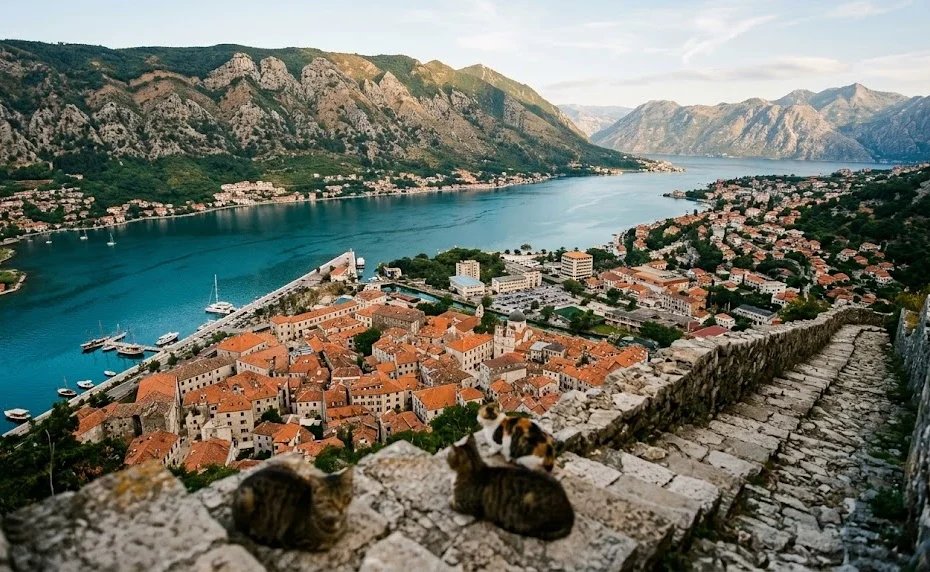
So let’s clear it up: Kotora melnkalne refers to Kotor, Montenegro — nothing more complicated than that. The town sits at the southeastern end of the Bay of Kotor, a winding, mountain-flanked inlet on the Adriatic coast. It’s small enough to walk across in twenty minutes, but layered enough to keep you occupied for two or three days.
The geography is the first thing that hits you. The bay is often called Europe’s southernmost fjord, but that’s not quite accurate. NASA’s Earth Observatory explains that the bay is actually a submerged river canyon, not a glacier-carved fjord — the old river valley was flooded when Adriatic sea levels rose and tectonic forces pushed the surrounding mountains upward. That geological quirk is why the water looks so enclosed and the mountains feel so close.
Once you understand that, the town’s layout makes sense. Kotor is a harbour town first, a fortress town second, and a tourist magnet third. The Old Town faces the water; the walls climb the mountain behind it.
Why Kotor Belongs on Your Balkan Itinerary
Plenty of Adriatic towns are pretty. Kotor is pretty and historically dense. In the Middle Ages, this natural harbour was a serious artistic and commercial centre, known for its schools of masonry and iconography. The town walls and a cluster of Romanesque churches — including the Cathedral of St. Tryphon — were badly damaged by a 1979 earthquake, but the town was restored with significant help from UNESCO.
That restoration matters. According to UNESCO’s World Heritage Centre, the Natural and Culturo-Historical Region of Kotor was inscribed in 1979 and has maintained the values for which it was listed. In plain English: this isn’t a theme-park reconstruction. The layers you see — Illyrian foundations, Roman traces, Venetian fortifications, Austro-Hungarian additions — are the real thing, repaired rather than replaced.
What does that mean for you as a visitor? It means the Old Town rewards slow wandering. The main square is handsome, but the real texture is in the side lanes: a fragment of Roman mosaic here, a Venetian lion carved into a wall there, a tiny church you almost walk past. If you treat Kotor as a quick photo stop between cruise ports, you’ll miss most of it.
The other reason to prioritise Kotor is that it pairs easily with the rest of the bay. Perast, a baroque village with two tiny islets, is a short bus or boat ride away. Herceg Novi sits at the bay’s entrance. And the whole area is compact enough that you don’t need a car to see the highlights — though having one gives you more flexibility.
The Old Town: What You’ll Actually Experience
Kotor’s Old Town is compact, pedestrian-only, and surrounded by walls that date back centuries. You enter through one of three gates; the Sea Gate is the main one, and walking through it for the first time is genuinely atmospheric. The stone underfoot is polished by centuries of use, and the buildings press close enough that the temperature drops a few degrees on a hot day.
A few things stand out:
- The cats. Kotor is nicknamed the “City of Cats,” and the feline population is part of daily life. You’ll see them curled on windowsills, weaving between café tables, and dozing on ancient stone. The local affection for cats is genuine — theories range from sailors bringing them ashore to protect food stores, to cats being seen as lucky after surviving wars and earthquakes. It’s a quirk, not a gimmick.
- The Cathedral of St. Tryphon. A Romanesque church with a turbulent history, rebuilt after earthquakes. It’s one of the town’s most recognisable landmarks and worth a short visit.
- The cafés. Kotor has a proper coffee culture, and sitting in a square with a small, strong coffee is one of the simplest pleasures here. Prices are reasonable by Western European standards.
- The crowds. This is the honest part. Kotor is a major cruise-ship port. In 2017, more than 493 ships brought over 535,000 tourists to the town, making it the third most trafficked cruise port in the Adriatic after Venice and Dubrovnik. On busy days, the Old Town can feel packed. The solution is simple: visit early in the morning or after the ships leave in the late afternoon.
The Bay of Kotor: Fjord, Canyon, or Something Else?
The bay is the reason the town exists, and it’s worth understanding what you’re looking at. As mentioned, it’s not a true fjord. It’s a drowned river canyon — a serpentine network of inlets and valleys that flooded when sea levels rose after the last ice age.
This matters for two reasons. First, the geology explains the landscape: steep rocky mountains plunging directly into deep water, with barely any coastal shelf. Second, it explains why the bay feels so enclosed. You’re not looking out at the open Adriatic; you’re inside a mountain-walled basin that twists and turns for roughly 28 kilometres.
The best way to appreciate the scale is to get on the water. A short boat trip toward Perast or out to the islets gives you a completely different perspective — the mountains loom larger, the water looks deeper, and you realise how sheltered the whole bay is. If you’re short on time, even a one-hour harbour cruise is worth it.
For hikers, the Lovćen mountains rise behind the bay and offer trails with views that stretch across the entire inlet. You don’t need to be an expert mountaineer to enjoy them, but you do need proper footwear and a basic sense of direction.
Climbing the Venetian Fortress (St. John’s Hill)
The fortress climb is Kotor’s signature experience — and its most misunderstood one. The walls that zigzag up the mountain behind the Old Town were built and rebuilt over centuries by the Illyrians, Byzantines, and Venetians. The present fortifications largely took shape during the Venetian period, particularly in the 16th and 17th centuries.
The trail starts at the eastern edge of the Old Town and climbs roughly 1,350 stone steps to a summit about 280 metres above sea level. That’s not a casual stroll. It’s a proper hike, often in direct sun, with uneven surfaces and loose stones.
Here’s what the guidebooks sometimes gloss over:
- Start early. The trail is exposed. By mid-morning in summer, the heat can be brutal.
- Bring more water than you think you need. There’s a small café partway up, but you shouldn’t rely on it being open.
- Wear shoes with grip. Trainers or hiking shoes are fine; flip-flops are not.
- Allow 2–3 hours round trip. Faster hikers can do it in less, but the views at the top — and the ruined fortress itself — deserve time.
- The ruins are unrestored. That’s part of the appeal. You’re walking through a genuinely old military site, not a polished museum.
The reward at the top is the view: the bay spread out below, the Old Town reduced to a pattern of terracotta roofs, and the mountains folding into the distance. On a clear day, it’s one of the best panoramas on the Adriatic coast.
When to Visit and How Long to Stay
Timing changes the Kotor experience more than almost any other factor. July and August bring heat, crowds, and higher prices. The shoulder seasons are far more comfortable.
Season Comparison: Kotor by Month
Season Weather Crowds Best For May–June Mild, 18–26°C, occasional rain Moderate Hiking, sightseeing, photography July–August Hot and dry, 26–30°C+ Very heavy (cruise ships + peak holiday) Swimming, boat trips, early mornings September–October Warm, 20–26°C, calmer Moderate to light Walking, fortress climb, café culture November–April Cool to cold, wet spells Very light Budget travel, atmospheric off-season
Lonely Planet’s Montenegro guide recommends May–June or September–October for mild weather, fewer crowds, and lower prices. That matches the on-the-ground experience: in late spring and early autumn, you can climb the fortress without overheating and walk the Old Town without shuffling behind a tour group.
How long should you stay? Two nights is the sweet spot for most travellers. That gives you one full day for the Old Town and fortress, and another half-day for the bay or Perast. If you’re using Kotor as a base for wider Montenegro exploration, three nights works well. If you’re just passing through on a cruise, you’ll see the highlights but miss the quieter rhythm.
What It Costs and How to Budget
Kotor isn’t a bargain-basement destination, but it’s more affordable than Dubrovnik or Venice. Budget trackers put the average daily cost for a traveller in Kotor at roughly $149 per person, though that figure includes mid-range choices. In practice, you can spend much less or much more depending on how you travel.
A rough breakdown:
- Budget traveller: $40–55 per day. Hostel dorms, local buses, street food or supermarket meals, and self-guided walking.
- Mid-range traveller: $100–$150 per day. Private rooms or simple hotels, restaurant meals, a boat trip, and paid entry to the fortress and churches.
- Comfort traveller: $200+ per day. Boutique hotels inside the walls, waterfront dinners, private transfers, and guided excursions.
Accommodation is the biggest variable. High-season hotel prices in Kotor average around $116 per night, but small private rooms and guesthouses can be found for €35–€50 outside peak weeks. Eating out is reasonable if you avoid the most tourist-facing squares; a simple grilled fish or plate of local pasta won’t break the bank.
One underrated cost saver: stay just outside the Old Town walls. Dobrota, the waterfront strip stretching north, has cheaper rooms and a quieter atmosphere, and it’s a 15–20 minute walk into town.
Practical Tips for First-Time Visitors
A few things I wish more people knew before arriving:
- Cruise-ship timing is everything. Check the port schedule if you can. On heavy ship days, the Old Town is best visited before 9 a.m. or after 5 p.m. The middle of the day belongs to the tours.
- You don’t need a car inside Kotor. Parking is limited and expensive. Use the town as a walking base and take buses or boats for day trips.
- The fortress entry fee is worth it, but bring cash. Card acceptance can be patchy at smaller gates and cafés.
- Perast is a half-day, not a full day. The two islets — Our Lady of the Rocks and St. George — are the main draw. Go early or late to avoid the midday rush.
- Kotor is not a beach town. There are small swimming spots along the bay, but if you want sand and sunbeds, you’re better off heading to Budva or the Luštica peninsula.
- Learn a few words. “Hvala” (thank you) and “molim” (please) go a long way. Montenegrins are generally warm toward visitors who make an effort.
FAQ: Kotora Melnkalne and Kotor Travel
What does “kotora melnkalne” mean?
It’s Latvian for “Kotor, Montenegro.” Kotora is the Latvian name for the town, and Melnkalne is the Latvian name for Montenegro. The term is simply a search phrase used by Latvian speakers planning a trip.
Is Kotor, Montenegro worth visiting?
Yes — especially if you like history, dramatic scenery, and walkable towns. The UNESCO-listed Old Town and the fortress climb are the highlights. Just time your visit to avoid the worst cruise-ship crowds.
How hard is the fortress climb in Kotor?
It’s a moderate hike, not a casual walk. Expect roughly 1,350 stone steps and about 280 metres of elevation gain. It takes most people 2–3 hours round trip. Wear grippy shoes and carry water.
What is the best month to visit Kotor?
May, June, September, and October offer the best balance of pleasant weather and manageable crowds. July and August are hot and busy; winter is quiet but often wet.
How many days do you need in Kotor?
Two nights is enough for most travellers. That covers the Old Town, the fortress, and a half-day on the bay. Add a third night if you want to explore Perast or use Kotor as a base for Lovćen.
Is Kotor expensive compared to Dubrovnik?
No — Kotor is generally more affordable. Mid-range accommodation, food, and activities cost less than in Dubrovnik, though prices have risen as the town has grown in popularity.
Conclusion
Kotor doesn’t need hype. The mountains do the talking, the walls do the history, and the bay does the scenery. If you’ve been searching for kotora melnkalne, you now know exactly what you’re looking at: a small Adriatic town with an outsized sense of place, best experienced slowly and slightly off-peak.
Go for the fortress view. Stay for the quiet morning lanes before the ships arrive. And leave room for a second coffee — because Kotor, for all its visitors, still rewards the traveller who sits still.
You Also Like To Read: Uploadwords.com USA: The Free Text Analysis Platform That Saves You Hours