Introduction
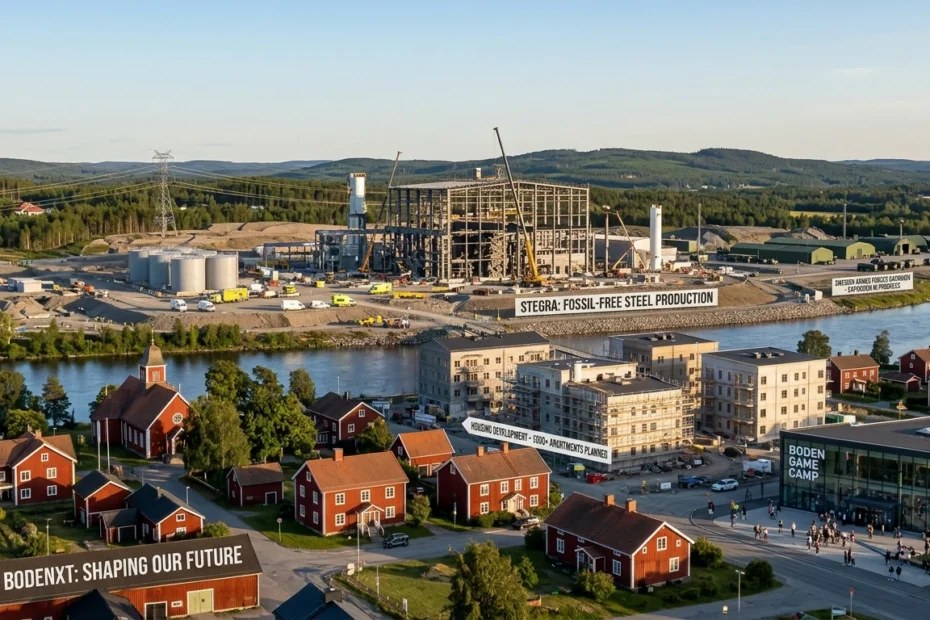
What happens when a quiet garrison town in northern Sweden suddenly becomes the center of Europe’s green steel ambitions—while the national defense simultaneously expands next door? That’s the live experiment unfolding in Boden, and Bodenxt is the official window into it.
You’ll learn what the platform actually does, why the stakes are unusually high, and what the transformation means for the people, businesses, and systems trying to keep pace. This isn’t a press release. It’s a practical guide to a real-world case study in rapid societal change.
Quick Overview
- Bodenxt is Boden Municipality’s official coordination platform for a fast-track industrial and community transformation.
- The two main engines are green industry (led by Stegra’s fossil-free steel plant) and Swedish defense expansion.
- The town is absorbing roughly 20 years of development in a fraction of that time.
- Focus areas include housing, infrastructure, schools, business growth, and skills supply.
- The biggest bottleneck is housing: rental vacancy is near zero, and construction is lagging demand.
- Local ecosystem projects include Boden Business Park and Boden Game Camp, a digital and gaming hub.
What Is Bodenxt and Why Should You Care?
Bodenxt is not a company, a brand, or a marketing campaign. It’s the municipality’s official transformation platform—a single place where news, project updates, films, and practical information about Boden’s industrial shift are collected and published.
Definition: Bodenxt is the Municipality of Boden’s coordinated platform for managing and communicating a large-scale societal and industrial transformation driven by green industry and defense growth.
Why should you care? Because Boden is a rare live test of what happens when global industrial shifts land in a small local community all at once. Most regions get years to adjust. Boden is getting a compressed timeline, and the way it handles housing, skills, and infrastructure will offer lessons for other towns facing similar pressures.
The platform’s own materials describe the pace bluntly: an estimated 20 years of societal development compressed into just a few years. That’s not a slogan. It’s a planning constraint that shapes everything from school capacity to road maintenance.
The Two Forces Driving Boden’s Transformation
Two clear engines are behind the change, and they reinforce each other.
First, green industry. Stegra—formerly H2 Green Steel—is building what’s intended to be the world’s first large-scale green steel plant just outside Boden. The company’s process replaces coal with green hydrogen, aiming to cut emissions by up to 95% compared with traditional steelmaking. The race to build Europe’s first commercial green steel plant has turned this remote northern site into a global reference point.
Second, defense expansion. Boden has long been a garrison town, and the Swedish Armed Forces are strengthening their presence as part of a broader national defense buildup. That means more soldiers, officers, and trainees arriving in a town that already has almost no spare housing.
According to municipal reporting, these two forces together are creating new jobs, a broader labor market, and a growing population—but also a set of bottlenecks that can’t be solved by industry alone.
The Green Steel Gamble: How Stegra Is Rewriting the Rules
Stegra’s plant is the single most visible symbol of the transformation, and it’s worth understanding how it actually works.
How Green Steel Production Works (in Plain English)
- Renewable electricity powers an electrolyser that splits water into hydrogen and oxygen.
- That green hydrogen is used to remove oxygen from iron ore in a direct reduction tower.
- The by-product is water vapor instead of carbon dioxide.
- The reduced iron is then processed into steel using electric arc furnaces.
- The entire chain is designed to be near-fossil-free, powered by local hydropower and wind.
The company has said the process can emit less than 200 kg of CO₂ per tonne of steel, compared with roughly 2 tonnes in conventional blast-furnace steelmaking. That’s the core promise.
Financing has been a moving target. H2 Green Steel’s fundraising for its Boden plant became an early signal of just how capital-intensive the project would be, and later financing rounds have continued to shape the timeline. The takeaway for readers isn’t the exact euro figure—it’s that building a new industrial model from scratch requires patient, large-scale capital and constant re-planning.
Traditional Steel vs. Green Steel: A Side-by-Side Look
- Primary reducing agent: Traditional steel uses coking coal; Stegra’s process uses green hydrogen.
- Main by-product: Traditional steel produces CO₂; the green process produces water vapor.
- Emissions per tonne: Traditional steel emits roughly 2 tonnes of CO₂; Stegra targets under 200 kg.
- Electricity demand: Traditional steel needs less; green steel needs very high electricity for electrolysis and electric furnaces.
- Location sensitivity: Traditional steel depends on port and coal access; green steel depends on renewable power access.
That comparison matters because it explains why Boden—with its hydropower and wind resources—ended up on the map. The plant isn’t there by accident. It’s there because the inputs align.
Housing: The Bottleneck That Could Slow Everything Down
If green steel is the headline, housing is the plot twist. Boden’s rental vacancy rate is close to zero. In practice, that means there are almost no available homes for new workers, families, or defense personnel.
The municipality has plans—around 1,300 apartments and 500 detached houses enabled through detailed development plans—but construction is moving slowly. High building costs, financing uncertainty, and the difficulty of making large projects financially viable are all cited as barriers. New homes that do get built are often filled almost immediately.
This isn’t just an inconvenience. It affects population growth, workforce recruitment, and the internal housing chain that lets young people leave home or older residents downsize. When a town can’t move people through its housing stock, the whole system tightens.
The municipality is exploring short-term fixes, including better use of existing properties and regional cooperation, but officials have been clear that these measures alone won’t close the gap. A significant increase in rental housing construction is needed to match the pace of job creation.
Skills, Schools, and the Race to Keep Up
A steel plant and an expanding regiment both need people—and not just engineers and soldiers. They need electricians, operators, logistics staff, teachers, healthcare workers, and service providers.
Bodenxt coordinates skills supply through dedicated municipal units, including a Skills and Relocation Unit that works on attracting talent and matching newcomers with employers. The challenge is not only recruiting from outside Sweden but also making sure that people who arrive can find housing, schooling, and a functional everyday life.
Schools are part of the same equation. A rapid population increase puts pressure on classrooms, teachers, and after-school services. The transformation isn’t just industrial; it’s civic infrastructure under strain.
Boden Business Park and Boden Game Camp: The Unexpected Ecosystem
Not everything in Boden is steel and defense. The town also hosts Boden Business Park, a hub for business development, and Boden Game Camp, a digital and gaming ecosystem with roughly 300 students and an incubator for game studios.
These projects matter because they show a different side of the transformation: diversification. A town that becomes too dependent on a single industry is vulnerable. Boden Game Camp, backed by regional and European development funding, is a small but deliberate attempt to build a broader economic base—one that can attract younger residents and remote-friendly talent.
It’s also a reminder that “industrial transformation” doesn’t only mean smokestacks. It can mean game studios, quality assurance, and digital education sitting alongside a steel plant.
What Makes Bodenxt Different From a Standard Economic Development Office?
Most municipal economic development offices publish newsletters and attend trade shows. Bodenxt functions more like a live coordination dashboard for a region in overdrive.
It brings together:
- Project information across housing, infrastructure, and industry.
- News and film that explain the transformation to residents and outside observers.
- Signposting to units and services that handle skills supply, relocation, and business support.
- A public-facing narrative that helps attract investors, workers, and attention.
In that sense, it’s a communication tool, a coordination layer, and a transparency mechanism all at once. Whether it succeeds will depend on whether the underlying systems—housing, schools, transport—can actually keep up.
Key Takeaways
- Bodenxt is the official platform for a compressed industrial and societal transformation in northern Sweden.
- Green steel and defense are the two main growth engines, and they are arriving simultaneously.
- Housing is the critical bottleneck: vacancy is near zero, and construction is not keeping pace with demand.
- Skills and infrastructure are being coordinated through municipal units and planning processes, but the pressure is intense.
- Boden Business Park and Boden Game Camp show an effort to diversify beyond heavy industry.
FAQ
What is Bodenxt?
Bodenxt is the Municipality of Boden’s official platform for coordinating and communicating the town’s rapid industrial and societal transformation. It gathers news, project information, and films about housing, infrastructure, industry, and skills supply.
Why is Boden important for green steel?
Boden hosts Stegra’s large-scale green steel plant, which uses green hydrogen instead of coal to reduce emissions by up to 95%. The town’s access to renewable electricity makes it a strategic location for the project.
Is Bodenxt a company?
No. Bodenxt is a municipal platform, not a private company. It sits within Boden Municipality and coordinates across public and private partners involved in the transformation.
What is the housing situation in Boden?
The rental vacancy rate is close to zero. The municipality has plans for new housing, but construction is slow due to high costs and financing challenges, creating a bottleneck for population growth and recruitment.
What is Boden Game Camp?
Boden Game Camp is a digital and gaming ecosystem in Boden with around 300 students, an incubator, and connections to Boden Business Park. It represents an effort to diversify the local economy beyond steel and defense.
How fast is Boden growing?
Boden’s population increased more than projected in recent years, with in-migration from other parts of Sweden rising sharply. Officials describe the pace as roughly 20 years of normal development compressed into a few years.
Conclusion
Boden’s transformation is not a distant policy story. It’s a live stress test of what happens when global industry and national security priorities converge on a small municipality with limited housing and a finite workforce.
Bodenxt gives you a front-row seat to that test—not a polished marketing version, but a running record of plans, pressures, and adjustments. Whether Boden succeeds will depend less on steel chemistry and more on whether the town can build homes, train people, and keep its civic systems intact while the world watches.
The next time you hear about green steel or Arctic defense, remember: the real story is often in the town where the workers need somewhere to live.
You Also Like To Read: BlessingTide.com USA: A Practical Guide for Safe, Smart Shopping