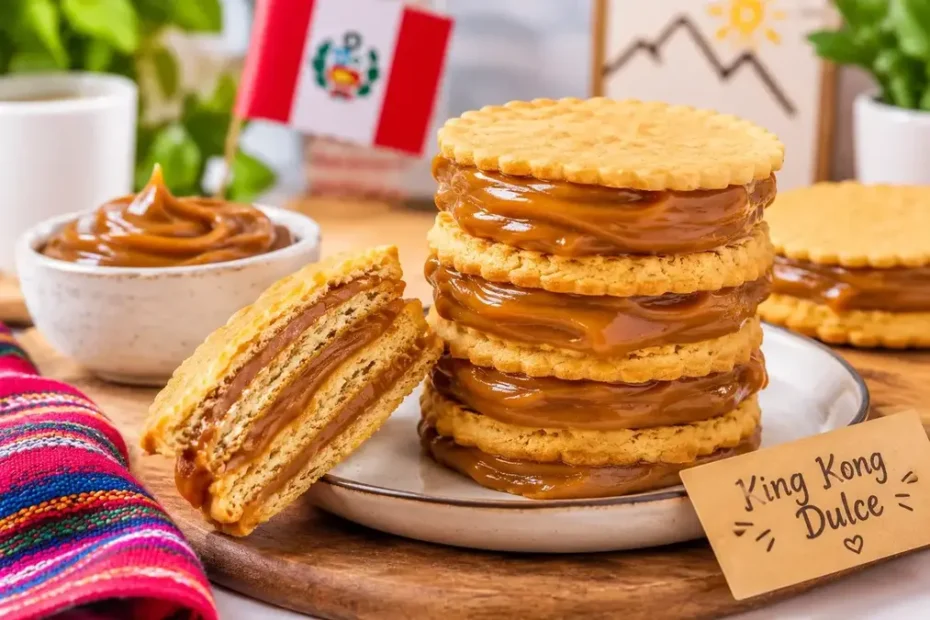
You crave that tall, caramel-stuffed Peruvian cookie, but every bakery within driving distance draws a blank. Typing “best king kong dulce near me” into your phone returns nothing useful — just chain coffee shops and cupcake stores miles away. This guide cuts through the noise and shows you exactly where to look, what to order, and how to spot real quality before you spend a single dollar.
What Exactly Is King Kong Dulce?
King Kong dulce is a towering Peruvian layered cookie filled with manjar blanco, the South American cousin of dulce de leche. Picture two to four golden, crisp cookie rounds stacked vertically with thick caramel cream spread between each one. The finished product stands several inches tall and delivers a satisfying crunch-then-melt bite.
The dough is simple: flour, butter, sugar, and egg yolks. The real magic lives in the filling. Authentic manjar blanco comes from slowly simmering sweetened milk for hours until it transforms into a deep amber, spreadable caramel. No shortcuts, no artificial thickeners.
You’ll find this treat in bakeries across Peru, but its popularity has spread to Latin American communities worldwide. If you’ve never tried one, you’re in for a serious upgrade from the standard sandwich cookie.
The Lambayeque Origin Story Behind Every Layer
King Kong dulce was born in Chiclayo, the capital of Peru’s northern Lambayeque region, during the early 1900s. Local bakers had access to abundant sugar cane and fresh dairy, giving them everything they needed to perfect the manjar blanco filling.
The name arrived in 1933, the same year the movie King Kong premiered in theaters. A Chiclayo baker reportedly looked at his tall, stacked creation and saw a resemblance to the giant ape climbing the Empire State Building. The nickname caught on instantly, and it has defined the product ever since.
Today, King Kong dulce holds deep cultural significance in Lambayeque. The Smithsonian Institution’s documentation of Latin American food traditions highlights how regional desserts like this one serve as living records of local agriculture, migration, and family heritage. Annual gastronomic festivals in Chiclayo feature King Kong competitions that draw thousands of visitors each year.
What Does Authentic King Kong Dulce Actually Taste Like?
Your first bite should crack slightly. The cookie layers are thin and golden — crisp, not soft or cakey. Then the manjar blanco takes over. It tastes like deeply caramelized milk, landing somewhere between toffee and warm condensed milk, with a smooth, almost fudgy finish.
The sweetness is bold but balanced. A well-made King Kong never tastes like raw sugar. You should pick up buttery, toasted notes from the cookie and a gentle vanilla warmth from the filling.
If you try a version with pineapple jam layered in, expect a tart, bright contrast that slices right through the caramel richness. That sweet-and-tangy combination surprises most first-timers in the best possible way.
How to Search for the Best King Kong Dulce Near Me (Step by Step)
Finding the best king kong dulce near me requires a slightly different approach than locating your average donut shop. Follow these practical steps to narrow your search quickly:
- Open Google Maps and type “Peruvian bakery near me” or “Latin American panadería.”
- Call before you drive. Many small bakeries make King Kong dulce only on weekends or for special orders.
- Check Latin grocery stores in your area. Scan the cookie aisle near the alfajores and imported sweets.
- Browse Facebook Marketplace and local Peruvian community groups. Home bakers frequently sell fresh batches through these channels.
- Visit nearby food halls or international markets that feature rotating Latin American vendors.
Don’t limit yourself to Peruvian-specific shops. Many Colombian, Ecuadorian, and Mexican bakeries also carry King Kong dulce because of its widespread popularity across South America.
Latin Bakeries and Markets Most Likely to Stock It
Your highest success rate comes from visiting panaderías in neighborhoods with strong Latin American populations. Cities like Miami, Los Angeles, Paterson (New Jersey), Houston, and Washington D.C. have dense Peruvian communities where this layered cookie is a bakery staple.
When you walk in, head straight for the glass display case near the register. King Kong dulce usually sits on small cardboard trays, sometimes wrapped in clear cellophane with a printed brand label. If you don’t spot it immediately, ask the counter staff. They may keep fresh batches in the back or prepare them to order.
Large Latin supermarket chains like Sedano’s, El Super, and Mi Tienda often carry packaged King Kong dulce from well-known Peruvian brands. Check the international cookie aisle first, then glance at the refrigerated section near the flan and tres leches cakes.
Packaged vs. Fresh-Baked: Which Option Should You Choose?
Fresh-baked King Kong dulce from a local bakery will almost always outperform the packaged version. The cookie layers stay crisp, the manjar blanco stays creamy, and you skip the preservatives that extend shelf life but flatten the flavor.
That said, packaged King Kong dulce from reputable Peruvian brands is a perfectly solid option when a bakery isn’t nearby. Brands like San José and King Kong Lambayeque ship their products carefully, and the quality stays consistent from box to box.
Here’s a simple rule: buy fresh for personal enjoyment and special occasions. Buy packaged for gifting, long-distance shipping, or keeping a backup stash in your pantry for late-night cravings.
Top King Kong Dulce Brands You Can Order Online Right Now
If your local search for the best king kong dulce near me still comes up empty, online ordering is your strongest backup plan. These brands carry solid reputations and ship across the United States:
- San José — One of the oldest producers, based in Lambayeque. Known for the classic manjar blanco filling and a slightly crumbly cookie texture that melts fast.
- King Kong Lambayeque — The most recognized name in the category. Offers classic, pineapple, and peanut varieties in multiple sizes.
- La Casa del King Kong — A smaller producer with a loyal following for its extra-thick manjar blanco layers and minimal preservatives.
- D’Onofrio — A major Peruvian brand better known for ice cream, but their King Kong dulce is widely available in Latin markets and online.
Check Amazon, specialty Latin food sites like Amigofoods, and even Etsy for small-batch sellers. Always read the most recent reviews and verify the expiration date before completing your purchase.
Flavor Variations Worth Trying at Least Once
The classic manjar blanco filling is the gold standard, but sticking to one flavor means missing out on some genuinely great combinations.
Pineapple (Piña): Layers of sweet pineapple jam alternate with manjar blanco. The natural acidity balances the caramel and keeps the overall sweetness from becoming overwhelming.
Peanut (Maní): Roasted ground peanuts add a salty crunch that pairs naturally with the dulce de leche. This version is a staple at Peruvian family gatherings and holiday tables.
Coconut (Coco): Shredded coconut brings a lighter, tropical feel to each bite. It’s less heavy than the classic and works especially well alongside afternoon coffee.
Chocolate: A modern twist where chocolate ganache joins the manjar blanco between layers. Traditionalists debate it, but the caramel-chocolate combination is genuinely hard to resist.
How to Store King Kong Dulce and Keep It Fresh Longer
Fresh King Kong dulce lasts about three to five days at room temperature if you store it in an airtight container. Avoid the refrigerator entirely — the moisture will soften the cookie layers and turn them soggy within hours.
For packaged versions, follow the printed expiration date and keep the box in a cool, dry spot away from direct sunlight. Once you open the seal, transfer any leftovers to a sealed container and eat them within a week for the best texture.
If you ordered online and the filling arrived slightly melted from transit heat, let the unopened box sit at room temperature for about an hour. The manjar blanco will firm up again without losing its creamy consistency.
Can You Make King Kong Dulce at Home?
You absolutely can, and the process is more straightforward than most people assume. The cookie dough comes together with basic pantry staples — flour, butter, sugar, and egg yolks. Roll it thin, cut even circles, and bake until golden around the edges.
The manjar blanco is where patience matters most. Simmer an unopened can of sweetened condensed milk in a water bath for two to three hours, checking the water level every thirty minutes. The result is a thick, amber caramel you’ll spread generously between the cooled cookie rounds.
Stack three or four layers, press down gently, and let the assembled King Kong rest for at least one hour before slicing. That resting period allows the filling to set and the flavors to merge properly.
Quality Checklist: What to Inspect Before You Spend a Single Dollar
Whether you’re standing inside a bakery or scrolling through an online product page, run through this quick checklist before handing over your money:
- Color: Cookie layers should be evenly golden, not pale or dark brown. Uneven coloring suggests inconsistent baking.
- Filling thickness: You should see a visible, generous layer of manjar blanco between each cookie. Thin, skimpy filling signals cost-cutting.
- Ingredient list: Look for real butter, milk, sugar, and eggs. The U.S. Food and Drug Administration’s nutrition labeling guidelines require all packaged foods to clearly disclose their ingredients — use this to your advantage and skip products loaded with hydrogenated oils.
- Smell: A fresh King Kong should smell buttery and caramel-like. Any chemical or stale odor means it’s well past its prime.
- Structure: The layers should hold together firmly when you pick it up. If they slide apart at a slight tilt, the filling ratio is off.
King Kong Dulce vs. Alfajores: Clearing Up the Confusion
People frequently mix up King Kong dulce and alfajores because both are Latin American cookie-and-dulce-de-leche treats. But they’re quite different once you look at them side by side.
Alfajores are small, round sandwich cookies — typically two thin discs with a modest layer of filling and a dusting of powdered sugar on top. They’re bite-sized, delicate, and easy to eat in two or three bites.
King Kong dulce is the opposite. It’s tall, multi-layered, and generously filled. A single King Kong can reach four to five inches in height and weighs significantly more than an alfajor. The cookie texture is also noticeably crispier, while alfajor cookies tend to be softer and more crumbly.
Think of alfajores as the dainty cousin and King Kong dulce as the show-stopping centerpiece of the dessert table.
Nutrition Facts and Dietary Details Worth Knowing
King Kong dulce is a dessert, so it’s not exactly a health food. A typical serving contains roughly 200 to 350 calories depending on the size and filling variety. The main calorie contributors are sugar, butter, and the sweetened condensed milk used in the manjar blanco.
If you have a gluten sensitivity, traditional King Kong dulce is off-limits because the cookie layers are wheat-based. A small number of home bakers and specialty shops offer gluten-free versions using almond or rice flour, but these are rare and worth confirming by phone before you visit.
For those watching their sugar intake, enjoy King Kong dulce as an occasional treat rather than a daily habit. One slice with a cup of black coffee is the traditional Peruvian way to eat it — and honestly, it’s the best way to appreciate the flavors without overdoing it.
King Kong Dulce Brand Profile and History
| Detail | Information |
| Brand Name | San José King Kong |
| Founded | 1914, Chiclayo, Lambayeque, Peru |
| Founder | Juan de Dios Mejía |
| Headquarters | Chiclayo, Lambayeque Region, Peru |
| Signature Product | Classic King Kong de Manjar Blanco |
| Product Range | Classic, Pineapple, Peanut, Coconut, and Assorted boxes |
| Distribution | Peru, United States, Spain, and select Latin American countries |
| Key Ingredients | Wheat flour, butter, sugar, eggs, sweetened condensed milk |
| Shelf Life (Packaged) | 4–6 months unopened in a cool, dry place |
| Cultural Status | Recognized as part of Lambayeque’s intangible culinary heritage |
| Where to Buy (U.S.) | Latin grocery stores, Amazon, Amigofoods, and specialty import shops |
| Price Range | 4–12 per package depending on size and variety |
Your search for the best king kong dulce near me doesn’t have to end in frustration. Start with the Latin bakeries and panaderías closest to you, call ahead to confirm availability, and don’t overlook the packaged options from trusted Peruvian brands when fresh isn’t an option. Once you bite into a real King Kong dulce — golden layers cracking under your teeth, thick caramel melting on your tongue — you’ll understand why Peruvians have guarded this recipe for over a century.
Stop scrolling and start searching. Open your maps app, type in “Peruvian bakery,” and go claim your first (or next) King Kong dulce this weekend. Your taste buds will thank you.
You Also Like To Read : Club Pui: A Complete Guide to What It Is and How to Get Involved