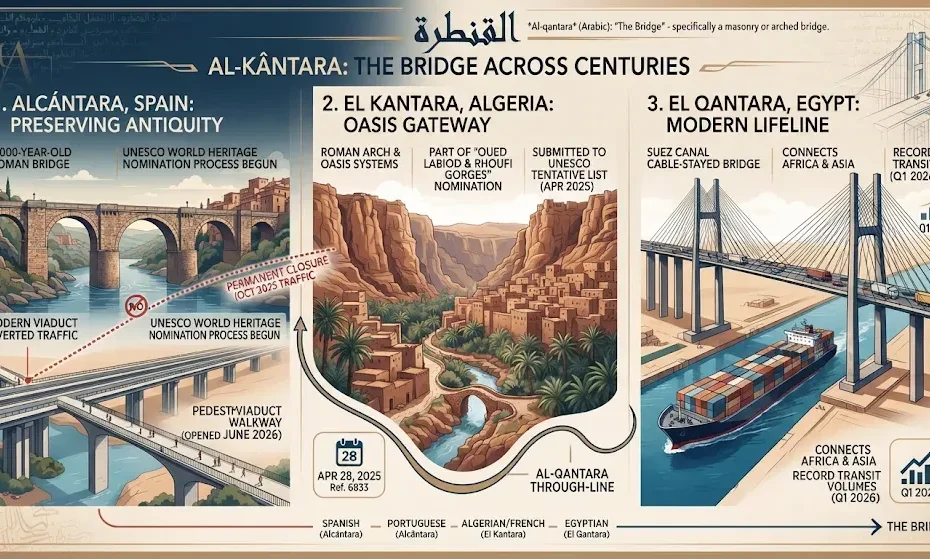
TL;DR: Al-Kântara (from Arabic al-qantara) means “the bridge.” In 2025–2026, its most famous sites hit major milestones: Spain’s Alcántara bridge was permanently closed to cars and entered the UNESCO race, while Algeria’s El Kantara advanced on UNESCO’s Tentative List—proving a single word still connects continents, centuries, and preservation fights.
You’re about to see a word that looks like a place, a history lesson, and a live news story all at once.
Al-Kântara is a transliteration of the Arabic القنطرة (al-qantara), which literally means “the bridge.” But in 2026, that definition feels almost too simple. Because the places that carry this name are no longer just surviving their past—they’re actively rewriting what happens next.
Spain’s Roman bridge at Alcántara was finally freed from daily truck traffic in late 2025 and is now on a formal path toward UNESCO World Heritage status. Algeria’s El Kantara is sitting on UNESCO’s Tentative List as part of a sweeping oasis nomination submitted in April 2025. And in Egypt, the El Qantara area remains a critical crossing point as the Suez Canal pushes record transit volumes in 2026.
If you want the full picture of what al-kântara means today—not just in a dictionary, but on the ground—this is it.
Quick Overview: What’s Happening with Al-Kântara Right Now
- The word: Al-qantara (القنطرة) means “the bridge” in Arabic—specifically a masonry or arched bridge.
- Spain (Alcántara): The 2,000-year-old Roman bridge was permanently closed to road traffic in October 2025; a €23 million viaduct now carries the load, and the regional government has formally begun the UNESCO nomination process.
- Spain (Alcántara, 2026): A 3.5-meter-wide pedestrian walkway opened alongside the new viaduct in June 2026, turning the site into a heritage destination rather than a highway.
- Algeria (El Kantara): The oasis town and its Roman bridge are part of the “Oasis Systems of the Rhoufi Gorges and Oued Labiod” nomination, officially submitted to UNESCO’s Tentative List on 28 April 2025 (Ref. 6833).
- Egypt (El Qantara): The Suez Canal Bridge remains a key fixed link between Africa and Asia; the canal itself is reporting record transit volumes in Q1 2026 after expansion work.
- The through-line: The same Arabic word describes a Roman arch, a modern cable-stayed span, and a desert oasis gateway—because “bridge” was never just about stone.
What Does Al-Kântara Actually Mean—and Why Does the Spelling Change?
Let’s lock down the definition first, because the word gets stretched in every direction.
Al-qantara (القنطرة) is an Arabic noun for a bridge, especially a stone or masonry bridge with arches. The *al-* makes it definite: “the bridge.” In classical lexicography, the root carries the sense of something firmly knit together or vaulted—which is why the word attached itself to structures built to last.
The spelling shifts because different languages absorbed the same Arabic word at different times, through different scripts. Spanish gave us Alcántara. Portuguese gave us Alcântara. North African French-influenced transliteration produced El Kantara. Egyptian Arabic yields El Qantara. And English-language sources sometimes render it al-Kântara with a circumflex.
They are not different words. They are the same word, doing what bridges do: adapting to the terrain.
| Language / Region | Form You’ll See | What It Usually Names |
|---|---|---|
| Spanish (Spain) | Alcántara | Town + Roman bridge over the Tagus in Cáceres |
| Portuguese (Portugal) | Alcântara | Lisbon parish + aqueduct arches |
| Algerian Arabic / French | El Kantara | Oasis town + gorge + Roman arch bridge in Biskra |
| Egyptian Arabic | El Qantara | Suez Canal crossing + cable-stayed bridge |
| English transliteration | al-Kântara | The Arabic root itself; “the bridge” |
That table is not trivia. It’s a map of how far a practical word can travel when the thing it describes is essential.
Alcántara, Spain: The 2025–2026 Story That Changed Everything
If you only follow one al-kântara site this year, follow this one. Because what happened in Alcántara between October 2025 and June 2026 is a textbook case of how heritage preservation actually works—and how a word on a map becomes a live policy decision.
The Problem: 600 Vehicles a Day on a 2,000-Year-Old Bridge
The Puente Romano at Alcántara was built around AD 105–106 under Trajan. It spans the Tagus River with six arches, rises nearly 60 meters, and has been a protected monument for a century. But until late 2025, it was still carrying roughly 600 vehicles per day, including 80 heavy trucks.
That’s not preservation. That’s attrition.
The Fix: A €23 Million Viaduct, Opened October 2025
On 20 October 2025, the regional government of Extremadura inaugurated a new 267-meter viaduct built with concrete and steel, at a cost of €23 million (some early reports cited €17 million for the initial construction phase). The new span carries road traffic. The Roman bridge does not.
At the inauguration, the president of Extremadura, María Guardiola, announced that the regional government would formally begin the process of requesting UNESCO World Heritage status for the Roman bridge. The logic was explicit: you can’t ask the world to recognize a monument while simultaneously driving trucks over it.
The official announcement from the Junta de Extremadura frames the decision in exactly those terms—modern infrastructure as the precondition for ancient preservation.
The 2026 Upgrade: A Pedestrian Walkway with “Unique Views”
By June 2026, the site had its next layer. A 3.5-meter-wide pedestrian walkway opened alongside the new viaduct, physically separated from the road, offering what regional officials described as “unique views” of the Roman bridge and the Tagus. The walkway is part of a larger pedestrian ring that will eventually allow visitors to walk a continuous loop between the old bridge and the new one.
This matters for two reasons. First, it turns the site from a drive-past monument into a destination. Second, it signals that the UNESCO bid is not just about the bridge as an object—it’s about the landscape, access, and experience around it.
The bridge itself also received new ornamental lighting in July 2026, another small piece of the same strategy: make the heritage asset visible, accessible, and worth protecting.
What to watch next: The UNESCO nomination process is multi-year. The formal request has been announced, but inscription—if it comes—will not happen overnight. The key benchmark is whether the Junta de Extremadura submits a complete nomination file to Spain’s national UNESCO commission, which then decides whether to forward it to Paris.
El Kantara, Algeria: A UNESCO Tentative List Entry with Real Momentum
Now cross the Mediterranean, because the Algerian al-kântara story has its own 2025–2026 timeline—and it’s just as consequential, even if it hasn’t produced a new bridge.
What Exactly Is on the Tentative List?
The site is not just “El Kantara the town.” It’s a mixed natural and cultural property called “Les systèmes oasiens des gorges du Rhoufi et d’Oued Labiod”—the oasis systems of the Rhoufi Gorges and the Oued Labiod valley. The nomination was officially submitted to UNESCO’s Tentative List on 28 April 2025, under reference 6833, with criteria (iii), (v), and (vii).
El Kantara is explicitly named in the UNESCO Tentative List description as “a major passage point between the mountains and the desert,” distinguished by its “spectacular rocky ridge cut by the opening of a valley”.
That language is not decorative. It’s the core of the nomination argument: this is a place where the Tell Atlas and the Sahara meet, where oasis agriculture and Berber architecture developed in direct response to a dramatic environmental transition, and where the Roman arched bridge and the gorge itself function as a single cultural landscape.
Why the “Bridge” Word Still Matters Here
El Kantara’s name comes from the same Arabic root: al-qantara, “the bridge.” The town sits at the El Kantara Gorge, a cleft only about 40 meters wide with walls rising up to 120 meters. The Roman bridge that once spanned the river below was part of a caravan and military route linking northern Algeria to the Sahara.
The oasis village’s older core, Dachra Dhahraouia (later called the “Red Village”), was founded by Berber families for its defensible heights overlooking the valley. The architecture uses local limestone, quartzite, and dolomite—sometimes incorporating reused Roman stone—and reflects a tradition of terraced hill villages that blend into the terrain rather than dominating it.
In other words, the al-kântara here is not just a bridge over water. It’s a bridge between ecological zones, between mountain and desert, between settled agriculture and transhumance. The Tentative List nomination treats that entire system as the heritage asset.
Travel note for 2026: If you’re planning to visit, the best window is October through April. Summer heat on the desert side is extreme, and the gorge is best experienced on foot. The town is small enough to explore without a car, though reaching viewpoints outside the center may require a local taxi.
El Qantara, Egypt: The Modern Al-Kântara in a Record-Breaking Year
The third major site flips the timeline: here, al-kântara is not ancient, not tentative, and not waiting for UNESCO. It’s a working piece of infrastructure at one of the world’s most important waterways—and 2026 has been a big year for the canal it crosses.
The Bridge Itself
The Suez Canal Bridge at El Qantara—also called the Mubarak Peace Bridge or the Egyptian-Japanese Friendship Bridge—opened in October 2001. It’s a cable-stayed structure with a 404-meter main span, 70-meter clearance over the canal, and a total length of 730 meters. It connects the Sinai Peninsula in Asia to the Nile Delta region in Africa.
The name is the point. El Qantara means “the bridge” in Egyptian Arabic. The town and the bridge share the name because the crossing was important enough to define the place.
The 2026 Context: Record Transit Volumes and Expansion
The Suez Canal Authority reported record transit volumes for Q1 2026, with further deepening, widening, and navigational upgrades planned to accommodate larger vessels. April 2026 set an all-time revenue high of $985 million with 2,210 vessels transiting the waterway.
That matters for the al-kântara story because the bridge at El Qantara is part of the canal’s dual identity: a maritime corridor and a terrestrial link. While ships move north and south, the bridge moves people and goods east and west—between continents.
It’s also a reminder that al-kântara is not a fossilized word. When Egyptians needed a name for a modern crossing over a modern canal, they reached for the same word their ancestors used for Roman arches. The technology changed. The word didn’t need to.
How the Three Al-Kântara Sites Compare in 2026
| Dimension | Alcántara, Spain | El Kantara, Algeria | El Qantara, Egypt |
|---|---|---|---|
| Bridge type | Roman stone arch (AD 105–106) | Roman arched bridge over Rhoufi Gorge | Cable-stayed road bridge (opened 2001) |
| Heritage status | National monument; UNESCO nomination process announced Oct 2025 | Part of UNESCO Tentative List submission (28 Apr 2025, Ref. 6833) | Not a heritage nomination; active infrastructure |
| 2026 milestone | Pedestrian walkway opened June 2026; traffic permanently diverted | Tentative List entry under evaluation; tourism guides updated for 2026 season | Suez Canal reports record Q1 2026 transit volumes |
| What “bridge” means here | Engineering preservation; freeing a monument from modern load | Ecological and cultural transition zone between mountain and desert | Continental link between Africa and Asia; canal crossing |
| Primary preservation challenge | Balancing tourism access with monument integrity | Developing oasis tourism without eroding Berber cultural practices | Managing canal expansion alongside fixed road links |
That table is the fastest way to see the range. Same word. Three completely different jobs.
Key Takeaways
- Al-Kântara comes from Arabic al-qantara, meaning “the bridge”—specifically a stone or arched bridge.
- Alcántara, Spain closed its Roman bridge to road traffic in October 2025 and began the UNESCO World Heritage nomination process; a pedestrian walkway opened in June 2026.
- El Kantara, Algeria is part of a Tentative List nomination submitted to UNESCO on 28 April 2025 (Ref. 6833), covering the oasis systems of the Rhoufi Gorges and Oued Labiod.
- El Qantara, Egypt is a modern cable-stayed bridge at a Suez Canal crossing that reported record transit volumes in Q1 2026.
- The word’s persistence across 2,000 years of bridge-building—Roman, Islamic, and modern—shows that “bridge” was never just a physical description. It was a way of naming what matters.
FAQ: What People Are Searching About Al-Kântara in 2026
What does al-kântara mean in English?
It means “the bridge.” The Arabic word al-qantara (القنطرة) refers to a bridge, especially a masonry or stone bridge with arches. The definite article *al-* makes it “the bridge,” which is why so many places named after a crossing carry this name.
Is Alcantara the same word as Al-Kântara?
Yes. Alcantara, Alcántara, Alcântara, El Kantara, El Qantara, and al-Kântara are all transliterations of the same Arabic root. The spelling changes by language and region; the meaning—“the bridge”—stays constant.
Why did Alcántara close its Roman bridge to cars in 2025?
The bridge was carrying about 600 vehicles per day, including 80 heavy trucks, after nearly 2,000 years of use. A new €23 million viaduct opened on 20 October 2025 to carry traffic, allowing the Roman structure to be preserved and considered for UNESCO World Heritage status.
Is El Kantara in Algeria a UNESCO World Heritage Site yet?
Not yet. It is part of a Tentative List submission called “Oasis Systems of the Rhoufi Gorges and Oued Labiod,” submitted on 28 April 2025. Tentative List status is the first formal step; actual inscription would come later if the nomination proceeds.
What is the Suez Canal Bridge at El Qantara?
It’s a cable-stayed road bridge crossing the Suez Canal at El Qantara, Egypt, opened in 2001. Also called the Mubarak Peace Bridge or the Egyptian-Japanese Friendship Bridge, it links the Sinai Peninsula in Asia to the Nile Delta in Africa. Its name comes from the Egyptian Arabic word for “the bridge.”
Is al-kântara only used for bridges?
In place names, it almost always refers to a bridge important enough to name a settlement after. The Arabic root can also carry the sense of an aqueduct or a vaulted structure, but the core meaning is a crossing point—something built to get you from one side to the other.
Conclusion: The Bridge Is Still Being Built
Al-Kântara started as a word for a structure. In 2026, it’s a word for a decision.
Alcántara decided to stop driving trucks over a monument and start asking the world to recognize it. El Kantara decided to frame its entire oasis landscape—gorge, bridge, village, palm grove—as a single heritage asset worth protecting. El Qantara kept doing what it has always done: moving people across a line that divides two continents.
The word hasn’t changed. “The bridge” still means “the bridge.” But what we’re willing to build, preserve, and nominate around that word has changed enormously.
The next time you see Alcántara on a Spanish map or El Qantara in a shipping report, you’ll know it’s not just a name. It’s a claim about what’s worth connecting—and what’s worth keeping.
You Also Like To Read: Transjoaimo in 2026: Verified Records, Real Operations, and What Shippers Must Check